Forehead lift in Turkey, priced after consultation. Endoscopic and open techniques. Fix heavy brows, deep lines, restore youthful brow position.
How Much Does a Forehead Lift Cost in Turkey in 2026?
In Istanbul the price of a forehead lift (brow lift) is set by the surgeon after a consultation; in the UK it costs €5,000–9,000 and in the USA $6,000–12,000. Both endoscopic and open techniques are available. Packages include hospital, hotel (5–7 nights), airport transfers, and aftercare.
The forehead lift is often misunderstood. It doesn’t smooth wrinkles the way Botox does – it physically raises the brow to a more youthful position and addresses the heavy, tired look that develops as forehead tissue descends with age.
| Technique | Turkey (2026) | UK | Germany | USA |
|---|---|---|---|---|
| Endoscopic Brow Lift | Quoted after consultation | €5,000–9,000 | €4,000–7,000 | $6,000–10,000 |
| Open (Coronal) Brow Lift | Quoted after consultation | €6,000–10,000 | €5,000–8,000 | $7,000–12,000 |
What Types of Forehead Lift Are Available?
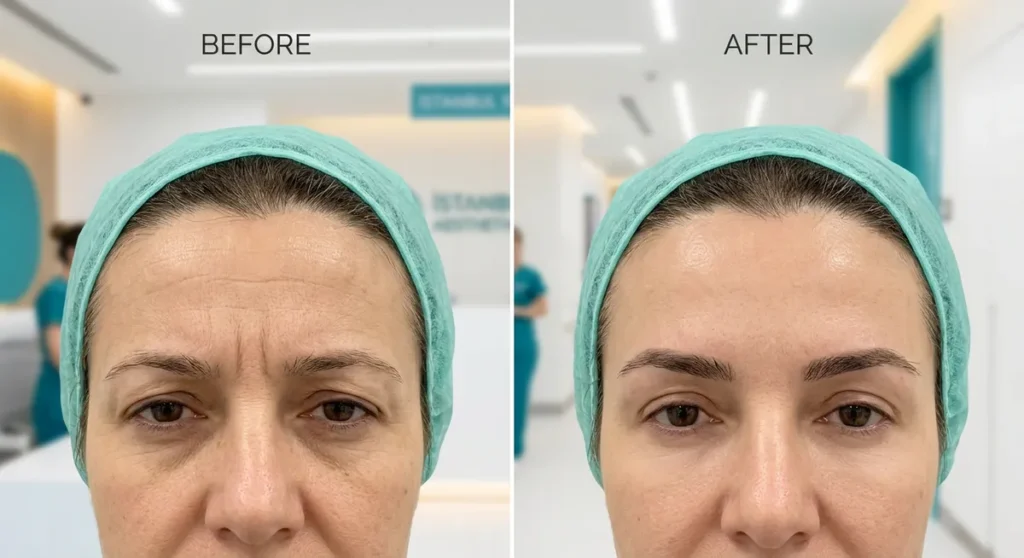
Two main approaches exist. The choice depends on your hairline position, the degree of brow descent, and how much correction is needed.
Endoscopic brow lift. The modern standard. Three to five small incisions hidden in the scalp. The surgeon uses a camera to visualize and reposition the brow tissue, then secures it with absorbable anchors or small screws. Minimal scarring, faster recovery (7–10 days). Best for mild to moderate brow descent.
Open (coronal) brow lift. A longer incision from ear to ear along the scalp (or just behind the hairline). Provides more dramatic lifting and allows removal of excess skin. Better for significant descent or patients who need substantial tissue removal. The trade-off is a longer scar (hidden in hair) and slightly longer recovery.
I recommend endoscopic for most patients. It gives predictable results with less downtime. But for patients with a high forehead who need the hairline advanced, or those with significant excess skin, the open technique is sometimes the better choice. Your surgeon assesses this during the virtual consultation based on your photos.
What Does the Recovery Look Like?
Surgery takes 1–2 hours under general anesthesia. Most patients stay one night in the hospital.
Days 1–3. Forehead feels tight. Moderate swelling, often extending down to the upper eyelids and causing temporary puffiness around the eyes. Compression bandage for 48 hours. Sleep with your head propped up.
Days 4–7. Sutures or anchors checked. Swelling shifting downward (this is normal and resolves). You can wash your hair carefully. Mild numbness on the scalp is expected and temporary.
Days 7–10. Cleared to fly. Swelling mostly resolved. Hairline incisions are hidden.
Month 1–3. Full results become visible as residual swelling resolves. Scalp sensation returns gradually.
The forehead lift has one of the smoother recoveries among facial surgeries. Most patients tell us the hardest part was the first 48 hours of tightness and the puffy eyelids – not pain.
Can I Combine a Forehead Lift with Other Procedures?
Absolutely, and most of our forehead lift patients do. The brow and forehead age alongside the rest of the face, so addressing them in isolation sometimes looks incomplete.
- Forehead lift + upper blepharoplasty – the most logical combination. Heavy brows push eyelid skin down, so lifting the brow often reduces the amount of eyelid skin that needs to be removed.
- Forehead lift + facelift – full facial rejuvenation. One recovery period.
- Forehead lift + cat eye surgery – lifts both the brow and outer eye corner for a combined youthful look.
Start with our Facial & Body Analysis if you’re unsure which combination makes sense for your face.
What Real Patients Ask Us (FAQ)
“Will my hairline change?” With the endoscopic technique, your hairline stays in the same position. With the open/coronal technique, the hairline may shift slightly backward. For patients with a high forehead, a hairline-incision technique can actually advance the hairline – discuss this during your consultation.
“Is it better than Botox?” They solve different problems. Botox temporarily relaxes muscles that cause dynamic wrinkles. A forehead lift physically repositions descended tissue. If your issue is that your brows sit too low and you look tired regardless of how rested you are, Botox won’t fix it – surgery will.
“How long do results last?” 7–12 years. You continue aging from the new position, but you’ll always look younger than if you hadn’t had the procedure. Sun protection and good skincare extend results.
Ready to Get a Real Quote?
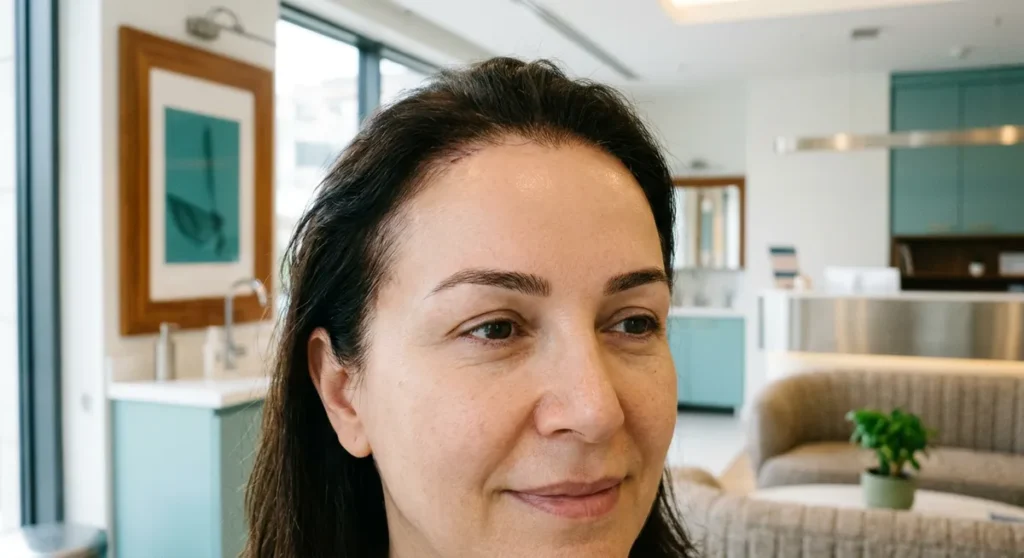
Send us front and profile photos on WhatsApp. We’ll have your surgeon assess your brow position and recommend the right approach.
WhatsApp: +90 546 229 38 34
Or fill out the contact form.
Endoscopic vs. Open Forehead Lift: Understanding the Techniques
The forehead lift is performed through two principal techniques. The traditional open (coronal) technique involves a single incision running from ear to ear across the top of the scalp, hidden within the hairline. Through this access, the forehead skin is elevated, the underlying muscles responsible for frowning and forehead creasing are modified, and the brow is repositioned. The open technique remains the gold standard for patients with significant brow ptosis, deep horizontal furrows, or those requiring substantial skin removal.
The endoscopic forehead lift uses three to five small incisions of one to two centimetres each, placed within the hairline. A thin camera and specialised instruments are inserted through these ports, allowing the surgeon to visualise and work on deeper tissues while making only minimal surface incisions. The forehead is elevated and secured using internal fixation devices — small bioabsorbable anchors — that hold tissues in their new position as healing proceeds. This technique is best suited for patients with mild to moderate brow descent and good skin elasticity, offering shorter scars, reduced scalp numbness, and faster healing.
Week-by-Week Recovery After a Forehead Lift
During the first three days, the forehead feels tight, numb, and tender, and swelling migrates downward causing puffiness around the eyes. The head should be kept elevated at all times, and cold compresses applied gently to the eye area. By the end of the first week, swelling begins to resolve noticeably and sutures or staples are typically removed. Scalp itching is common as sensation begins to return — this is a normal part of nerve regeneration.
Weeks two and three mark a significant improvement in social appearance. Residual bruising can be covered with make-up, and most patients feel comfortable in low-key public settings. By month three, the operated tissues have largely settled and brow position reflects the final surgical outcome. Any residual firmness along incision lines continues to soften through months four to six.
Long-Term Results and Realistic Expectations
A well-performed forehead lift produces a refreshed, alert appearance by restoring brow position to a more youthful level and smoothing the forehead and glabellar region. The results are intended to look natural — a rested version of yourself rather than a surgically altered one. Patients commonly report that friends comment on how well-rested they look, without identifying surgery as the cause.
A forehead lift does not halt the ageing process. Gravity, sun exposure, and intrinsic tissue ageing continue after surgery, and brow position will gradually descend again over subsequent years. However, because the surgery repositions tissues rather than simply tightening skin, the structural improvement is genuine and long-lasting, typically lasting seven to twelve years. Complementary treatments — including botulinum toxin to the glabella and forehead — can extend the duration of results and are frequently integrated into a longer-term maintenance plan.
FAQ
Can't find what you're looking for?
Contact us
or message us
Quick answers to questions
you may have
Your Most Important Questions, Answered
Will a forehead lift eliminate my need for Botox?
A forehead lift addresses static wrinkles and repositions sagging tissue, significantly reducing horizontal lines and frown lines. However, dynamic wrinkles (those appearing with expression) may still benefit from Botox. Many patients use much less Botox after surgery, needing it only for fine-tuning rather than major lifting. Combine with skin rejuvenation treatments for optimal texture.
How do I know if I need a brow lift or just eyelid surgery?
Your surgeon determines this during examination with facial analysis. A simple test: gently lift your brow with your finger. If this opens your eye significantly, you need a brow lift. If excess eyelid skin remains even with brow lifted, you need blepharoplasty too. Many patients need both for optimal results, often adding cat eye surgery for complete transformation.
Will a forehead lift change my hairline?
It depends on the technique. Endoscopic face lift and temporal lifts minimally affect hairline. Coronal lifts raise hairline 1-2cm. Trichophytic technique actually lowers high hairlines. Direct and thread lifts don’t affect hairline at all. If concerned about hair loss, discuss hair PRP therapy or FUE hair transplant options during consultation.
Can forehead lift correct asymmetric brows?
Yes, skilled surgeons can create symmetry by lifting each brow differently. This requires experience and artistic eye. Turkish surgeons’ high volumes (15-20 monthly) mean extensive experience with asymmetry correction. Perfect symmetry isn’t always the goal – faces are naturally slightly asymmetric. Facial analysis helps plan optimal correction.
Is forehead lift suitable for men?
Absolutely, but technique modifications ensure masculine results. Male brows sit lower and straighter than female brows. Surgeons must avoid over-elevation or excessive arching. Endoscopic or direct techniques work well for men. Many men combine with hair transplant consultation, hair loss treatment, and teeth whitening for complete transformation. Scar camouflage considerations differ with male pattern baldness.
How long before I look normal after forehead lift?
Social recovery varies by technique. Endoscopic: 7-10 days with hair styling covering incisions. Traditional: 2-3 weeks for swelling/bruising resolution. Direct: 5-7 days but visible scar initially. Most patients comfortable in public by 2 weeks with concealer if needed. Perfect timing for dental consultations and skin rejuvenation treatments during recovery.
Can I combine forehead lift with dental work?
Absolutely! Days 5-8 of recovery are ideal for dental implants consultations, teeth whitening, and aesthetic dentistry planning. You’re comfortable but not yet traveling. Turkish clinics excel at coordinating between departments. Package deals save 25-30% versus separate trips. Many patients complete their entire smile makeover during forehead lift recovery.
Can I have a forehead lift if I've had previous Botox?
Yes, but inform your surgeon about recent Botox treatments. It’s actually helpful – if Botox gave good results, surgery can create similar but permanent improvement. Some surgeons recommend stopping Botox 3-4 months before surgery to assess true brow position, while others operate with Botox effects present. This won’t affect your ability to have skin rejuvenation or other treatments during recovery.
Why our prices say «from»
Every figure on this page is a starting price for one confirmed, specific option — not an average and not a package. What changes the final number:
- the area treated and the volume of work
- the technique the surgeon chooses after seeing your case
- whether the procedure is combined with another one in the same session
- implants or materials, where the case needs them
The final amount is confirmed by the doctor after a panoramic X-ray or an in-person assessment — until then any figure, including ours, is an estimate. We quote from a single confirmed price list, so the number you hear on WhatsApp is the same one you see here. If you are already in Istanbul, the consultation and the X-ray are free.