
Orthodontic Treatments in Turkey: Prices, Options, and What Nobody Tells You (2026)
Orthodontic treatment in Turkey from €1,000. Invisalign, ceramic braces, lingual braces. Real prices March 2026. Remote monitoring between visits. Sante Clinic.
Table of Contents
Get free quote
How Much Does Orthodontic Treatment Cost in Turkey in 2026?
Orthodontic treatment in Istanbul costs €1,000–3,500 as of March 2026, compared to €3,500–7,000 in the UK and $4,000–8,000 in the USA. Invisalign clear aligners start at €1,200 in Turkey versus €3,500+ in London. All packages at Sante Clinic include the initial scan, treatment planning, and retainers.
Here’s the honest part about orthodontics abroad: it’s not like flying in for a one-week dental procedure. Braces and aligners take 6–18 months. You’ll need 2–3 visits to Istanbul total, with the rest managed remotely. This works well for clear aligners (you receive batches of trays shipped to your home). It’s trickier with traditional braces that need monthly adjustments.
| Treatment | Turkey (2026) | UK | Germany | USA |
|---|---|---|---|---|
| Invisalign (Full) | €3,000–5,000 | €3,500–5,500 | €3,000–5,000 | $4,000–7,000 |
| Ceramic Braces | €2,500–3,500 | €2,500–4,500 | €2,000–4,000 | $3,500–6,000 |
| Lingual Braces | Quoted after your X-ray | €5,000–8,000 | €4,000–7,000 | $6,000–10,000 |
What Types of Orthodontic Treatment Are Available?
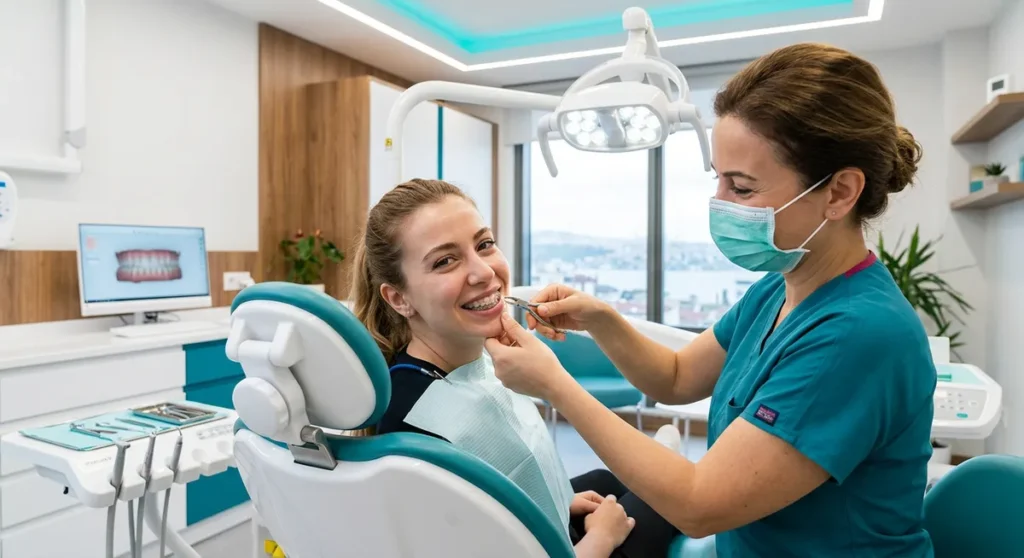
Four main orthodontic options are offered at our partner clinics in Istanbul. Each has trade-offs in visibility, comfort, treatment time, and how well it works for remote management.
Invisalign (clear aligners). The best option for medical tourism patients. You visit Istanbul for the initial 3D scan (iTero scanner), the orthodontist designs your treatment plan, and you receive your aligners in batches. You change trays every 1–2 weeks at home. Check-ins happen via video call and progress photos. One return visit mid-treatment, and a final visit for retainer fitting. Total: 2–3 trips to Istanbul over 12–18 months.
Ceramic braces. Tooth-colored brackets that blend with your teeth. Less visible than metal but still require regular adjustments. For patients in Turkey, this means visiting every 6–8 weeks – not practical for most international patients unless you live in Istanbul or can visit frequently. We’re honest about this: if you can’t commit to regular visits, aligners are the better choice.
Lingual braces. Brackets bonded to the back of your teeth – completely invisible from the front. Premium option with a higher price tag. Same adjustment frequency issue as ceramic braces. Best for patients who’ll be in Istanbul long-term or can arrange frequent visits.
Accelerated orthodontics. Techniques like micro-osteoperforations or Propel that speed up tooth movement by 30–50%. Can reduce total treatment time from 18 months to 10–12 months. Available as an add-on for €300–600.
I personally recommend Invisalign for anyone coming from abroad. The remote monitoring works, the results are predictable with 3D planning, and you don’t need to be in Istanbul every month. For complex cases with severe crowding or bite issues, traditional braces may still be necessary – your orthodontist will advise during the initial scan.
What Does the Treatment Process Look Like?
Orthodontic treatment in Istanbul is structured around 2–3 in-person visits spread over the treatment duration (typically 12–18 months for Invisalign).
Visit 1 (3–4 days in Istanbul): Day 1: Arrival, hotel check-in. Day 2: Full orthodontic assessment – 3D iTero scan, X-rays, photos, bite analysis. The orthodontist uses 3D simulation software to show you the projected result before you commit. Day 3: Treatment plan review, you approve the plan and aligners are ordered. If getting ceramic or lingual braces, they’re fitted on this day. Day 4: Return home.
Remote phase (6–12 months): Your aligners are shipped in batches to your home address. You change trays every 1–2 weeks. We schedule video check-ins every 4–6 weeks where you send progress photos. The orthodontist reviews movement and adjusts the plan if needed.
Visit 2 (2–3 days, optional): Mid-treatment refinement if needed. Some patients need IPR (interproximal reduction – gentle filing between teeth to create space) or attachment placement. Not everyone needs this visit.
Final visit (2–3 days): Retainer fitting – both a fixed wire behind the front teeth and a removable clear retainer for nighttime use. Final photos and X-rays. You’re done.
My partner coordinates shipping logistics and appointment scheduling. She’s in contact with the orthodontist’s office weekly to track your case progress even when you’re at home.
Is Orthodontic Treatment in Turkey Safe?
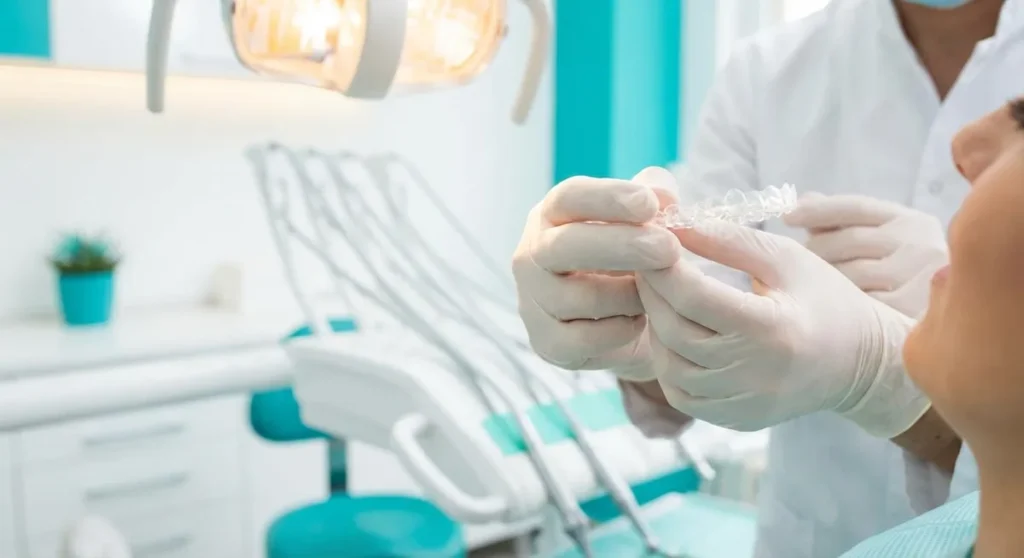
Orthodontic treatment carries minimal risk compared to surgical procedures. It’s non-invasive – no anesthesia, no incisions, no hospital stay. The main risks are related to oral hygiene (braces can trap food and cause cavities if not cleaned properly) and root resorption (slight shortening of tooth roots, affects 1–3% of patients, usually clinically insignificant).
The bigger question for international patients is: can treatment quality be maintained remotely?
For Invisalign, yes. The treatment is pre-planned digitally, and each tray is manufactured to precise specifications. Remote monitoring through photos and video calls works because the orthodontist can verify that each tray is fitting correctly and teeth are tracking as planned. Studies published in the American Journal of Orthodontics have shown comparable outcomes between remote-monitored and in-office aligner treatments.
For traditional braces, remote management is harder. Wire adjustments need to be done in person. If you choose braces, you’ll need a local orthodontist in your home country who can handle mid-treatment adjustments while your Istanbul orthodontist manages the overall plan. We can help coordinate this, but it adds complexity.
When Is Orthodontics NOT Worth Doing in Turkey?
I’ll be straight with you. Orthodontic treatment in Turkey doesn’t make sense for everyone.
Skip it if: your case is mild (minor crowding or spacing). Local treatment with at-home aligners (Invisalign Go, SmileDirectClub) may cost less once you factor in flights. For simple cases, the savings don’t justify the logistics.
Consider it if: you need comprehensive treatment (full Invisalign, significant bite correction) and the price difference is €2,000+. Or if you’re already coming to Istanbul for other dental work – adding orthodontic scanning to the same trip costs almost nothing in extra travel.
Definitely consider it if: you need orthodontics combined with other dental work. Many of our patients start with orthodontics to align teeth, then return for veneers or implants once alignment is complete. Planning both together from the start ensures the best final result.
Already have a quote from another clinic?
We will check it line by line for free — what is missing and what usually gets added after arrival. How we check
What Real Patients Ask Us (FAQ)
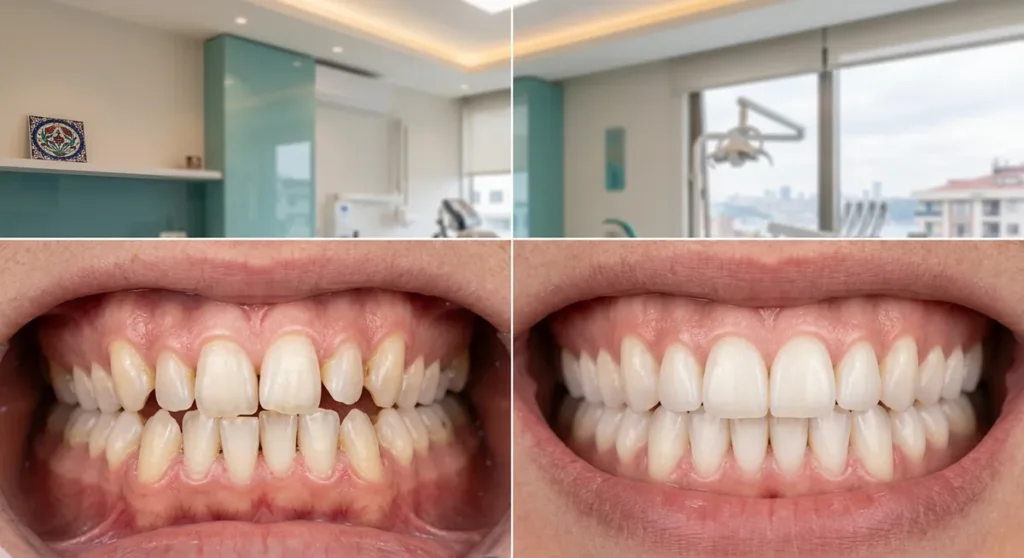
“Can adults get braces in Turkey?” Absolutely. About 60% of our orthodontic patients are adults aged 25–50. There’s no age limit for orthodontic treatment as long as your teeth and gums are healthy.
“How often do I need to visit Istanbul?” For Invisalign: 2–3 visits over 12–18 months. For braces: more frequent visits are needed (every 6–8 weeks), which is why we generally recommend aligners for international patients.
“Will I need to wear a retainer forever?” Yes, at night. Without a retainer, teeth gradually shift back. This applies regardless of which country you get treated in. We provide both a fixed wire retainer and a removable clear retainer.
“Can I combine orthodontics with teeth whitening?” Yes. We typically do whitening after braces or aligners are removed, so you reveal your newly straight teeth at their brightest. Teeth whitening is a 45-minute add-on at the final visit.
“What if a tray doesn’t fit or something goes wrong between visits?” Contact us immediately. We arrange a video call with your orthodontist within 24–48 hours. In most cases, the issue is resolved by adjusting wear schedule or moving to the next tray. If an in-person visit is needed, we schedule it promptly.
Ready to Get a Real Quote?
Send us photos of your teeth on WhatsApp. Front view, both sides, and upper/lower arches. Within 48 hours, your orthodontist will provide an initial assessment and estimated treatment plan.
WhatsApp: +90 546 229 38 34
Or fill out the contact form and we’ll call you back.
Quick answers to questions
you may have
Your Most Important Questions, Answered
How many trips to Turkey will I need for orthodontic treatment?
Most patients need just 2-3 visits: initial setup (3-4 days), optional mid-treatment refinement (2-3 days), and final removal/retainer fitting (2-3 days). Invisalign patients often manage with only two visits. Remote monitoring handles everything between visits, providing better oversight than traditional monthly appointments.
Can I really manage Invisalign treatment from another country?
Absolutely. Thousands complete Invisalign with Turkish providers while living abroad. Weekly smartphone scanning through monitoring apps allows your orthodontist to track every tooth’s movement in 3D. You receive aligners in batches, change them at home, and have video consultations as needed. It’s actually more supervised than traditional treatment.
What happens if I need an emergency adjustment?
True orthodontic emergencies are rare. Most issues (loose bracket, poking wire, lost aligner) have simple solutions we teach you. For actual emergencies, partner orthodontists in major UK/European cities can help. The monitoring app usually catches problems early, allowing preventive intervention before emergencies develop.
How does remote monitoring actually work?
You take photos weekly using the monitoring app (takes 5 minutes). AI analyzes tooth positions, comparing actual to planned movement. Your orthodontist reviews within 48 hours, sending instructions if needed. You see progress percentages, receive reports, and can message directly. It’s more transparent than traditional orthodontics.
Can I combine orthodontics with other dental work?
Yes, but sequence matters. Orthodontics first to position teeth, then whitening to desired shade, finally aesthetic work like veneers if needed. Many find that after straightening and whitening, they don’t need veneers. Your Turkish coordinator helps plan the optimal sequence for all treatments.
Will my local dentist know I had treatment abroad?
Your local dentist will see high-quality orthodontic work with no indication it was done abroad. You receive complete English documentation including treatment records, X-rays, and progress reports. Many local dentists are impressed by the technology and thorough documentation Turkish clinics provide.
Is accelerated orthodontics worth the extra cost?
For international patients, often yes. Reducing treatment from 18 to 9-12 months means fewer visits and faster results. The additional £300-600 is often offset by savings on flights and time off work. Discuss with your orthodontist whether you’re a candidate for acceleration devices.