Transform your profile and breathing with Turkey’s highly regarded rhinoplasty surgeons, who perform thousands of successful nose surgeries annually using advanced techniques at a fraction of Western prices.
Getting a nose job in another country is not a casual decision. Your nose sits in the centre of your face, and the margin for error is measured in millimetres. That’s why most of the content on this page isn’t about selling you a surgery – it’s about helping you figure out whether Turkey is the right place for yours, and whether we’re the right team to coordinate it.
At Santé, we’ve arranged rhinoplasty procedures for patients from the UK, Germany, across Europe, and beyond. Some came for first-time surgery. Others came to fix work done elsewhere. Every case was different. And we treated it that way.
Here’s what you actually need to know – pricing, process, risks, and the stuff other clinics leave out.
How Much Does a Nose Job Cost in Turkey in 2026?
A standard rhinoplasty in Turkey costs approx. €3,000 (septoplasty is priced separately). Revision rhinoplasty (correcting a previous surgery) is quoted after consultation, because the tissue is scarred and the surgical work is more complex.
Here’s how Turkey compares to other countries:
| Country | Rhinoplasty | Revision Rhinoplasty |
|---|---|---|
| Turkey | approx. €3,000 | Quoted after consultation |
| UK | £5,000 – £10,000 | £7,000 – £14,000 |
| Germany | €5,000 – €12,000 | €7,000 – €15,000 |
| USA | $8,000 – $15,000 | $10,000 – $20,000 |
The price gap isn’t about lower quality. Turkey’s cost of living is lower, hospital operating costs are lower, and Turkish surgeons perform a very high volume of rhinoplasties – which actually works in your favour when it comes to experience. According to ISAPS global statistics, Turkey consistently ranks among the top countries worldwide for rhinoplasty procedures performed.
What’s included in a Santé package:
- Board-certified plastic surgeon
- Hospital stay (1 night)
- Hotel accommodation (5–7 nights)
- Airport transfers
- All medications
- Post-operative care and follow-up appointments
- Splint removal before you fly home
What’s not included: flights and personal expenses. We’re upfront about that because some clinics bury the exclusions.
From our founder: “I lived in Turkey for 5 years, and I’ve seen what drives prices down at some clinics. It’s volume. Some surgeons do 6 to 8 rhinoplasties per day, moving between 3 or 4 different clinics. They spend 45 minutes per patient. That’s not a nose job – that’s a factory line. Our surgeons don’t work that way. We limit daily cases so your surgeon isn’t rushing to the next operating table.”
What Types of Rhinoplasty Are Available?
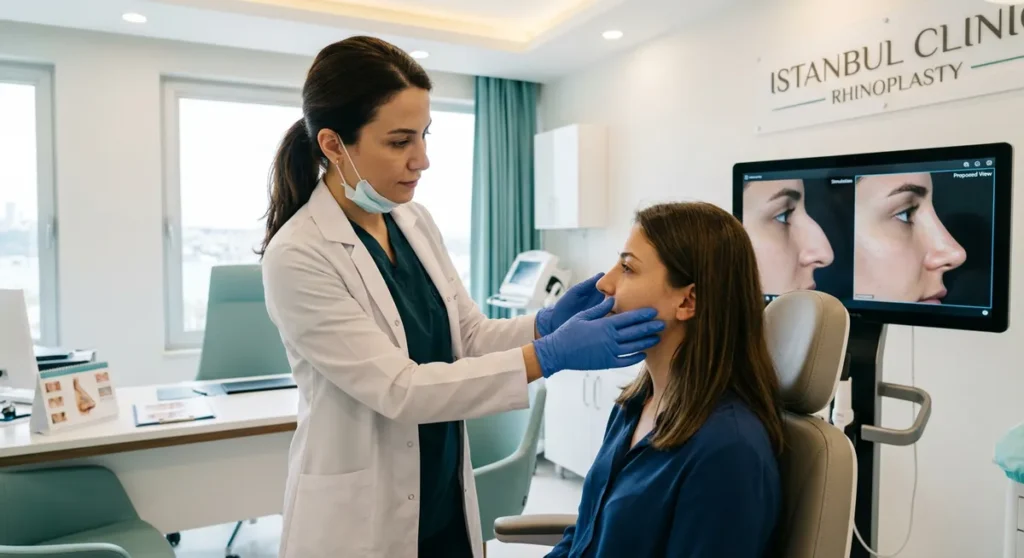
Turkey offers every major type of rhinoplasty, and your surgeon will recommend the right approach based on your anatomy, breathing function, and goals. The main distinction is between open and closed technique, but the real decision depends on what your nose needs.
Open rhinoplasty involves a small incision on the columella (the strip of tissue between your nostrils). This gives the surgeon full visibility of the nasal structure. It’s the preferred approach for complex reshaping, significant tip work, or revision cases. The trade-off: a tiny scar that fades over several months.
Closed rhinoplasty keeps all incisions inside the nostrils. No visible scarring. It works well for patients who need more limited changes – a dorsal hump reduction, for example, or minor tip refinement. Recovery can be slightly faster.
Septorhinoplasty combines cosmetic reshaping with correction of a deviated septum. If you have breathing problems alongside aesthetic concerns, this addresses both in one procedure. It’s more common than people think. Many patients who come to us for a cosmetic nose job discover during the pre-op CT scan that they also have a septal deviation.
Ethnic rhinoplasty refers to techniques adapted for different nasal structures – thicker skin, wider nostrils, lower bridges. A good surgeon doesn’t try to give everyone the same nose. The goal is a result that fits your face and respects your features.
Revision rhinoplasty. This deserves its own conversation.
Turkey has become a destination for revision rhinoplasty specifically because so many experienced surgeons here have handled difficult cases. A revision means operating on tissue that’s already been cut, grafted, or reshaped. Scar tissue behaves differently. Cartilage may have been over-removed. The surgery takes longer, costs more, and the margin for error is even smaller.
If you need a revision, make sure – absolutely sure – your surgeon specialises in revision cases. Not every rhinoplasty surgeon does.
What Does the Surgery and Recovery Process Look Like?
The procedure itself takes 1.5 to 3 hours under general anaesthesia, with one night in hospital. But the real timeline is what happens after.
Here’s an honest recovery breakdown:
- Day 1–2: Swelling, bruising around the eyes, nasal congestion. You’ll breathe through your mouth. It’s uncomfortable, not painful for most patients.
- Day 7: Splint and cast removal. Your nose will look different immediately, but it’s still swollen. Don’t judge the result yet.
- Week 2–3: Most bruising fades. You can return to desk work. Social situations become comfortable again.
- Month 2–3: About 80% of swelling resolves. Your nose starts looking closer to the final shape.
- Month 6–12: Subtle changes continue, especially in the tip.
- Month 12–18: Final result. This is not an exaggeration. Tip refinement genuinely takes this long, particularly with thicker skin.
The hardest part of recovery isn’t physical. It’s psychological. You’ll have days in the first few months where you think your nose looks worse than before surgery. Swelling is uneven. One side may settle faster than the other. This is normal, and your surgeon will confirm it during follow-ups. But no one warns patients about this emotional rollercoaster beforehand. We do.
Before you fly home, your cast comes off, you have a post-op consultation with your surgeon, and we provide detailed aftercare instructions. You’ll also receive a direct line to our team for questions that come up once you’re back.
How Do We Choose Your Surgeon?
Your surgeon is the single most important variable in rhinoplasty. More than the hospital, more than the price, more than the country.
We work with board-certified plastic surgeons in Istanbul who operate in JCI-accredited hospitals. JCI (Joint Commission International) is the global gold standard for hospital accreditation. But credentials on paper aren’t enough.
From our founder: “My partner attends every pre-op consultation and every post-op check. She confirms that the surgeon assigned to your case is the one who actually operates. This sounds obvious, but in Istanbul it isn’t always. Some clinics do a bait-and-switch – a senior surgeon does the consultation, then a junior surgeon performs the procedure. That doesn’t happen with us because we’re physically in the room.”
Our surgeons work in the Sisli and Besiktas districts of Istanbul, where the major private hospitals are concentrated. We don’t rotate between a dozen surgeons. We’ve built long-term relationships with a small number of specialists and we know their strengths. Some are better with primary rhinoplasty. Others are revision experts. We match based on your specific case, not availability.
Before surgery, you’ll receive 3D imaging that simulates potential results. This is a useful communication tool – it helps you and the surgeon agree on goals. But we tell every patient the same thing: the 3D image is a projection, not a guarantee. Your skin thickness, cartilage strength, and healing response all influence the final outcome.
Is Rhinoplasty in Turkey Safe?
Yes, when you choose the right surgeon and facility. Turkey’s top hospitals meet international standards, and the sheer volume of rhinoplasties performed here means experienced surgeons have seen virtually every variation of nasal anatomy.
But let’s not pretend the risks don’t exist.
Every surgery carries risks: infection, bleeding, anaesthesia reactions, asymmetry, breathing changes. And rhinoplasty specifically has a global revision rate of 5–15%, according to published data in peer-reviewed literature. That’s not a Turkey statistic. That’s the worldwide average, including the US and Europe.
The risks increase when:
- Your surgeon is overbooked and rushes the procedure
- The clinic prioritises price over quality (beware packages under €2,000 – something is being cut, and it might be corners)
- You don’t disclose your full medical history
- You smoke and don’t stop before and after surgery as instructed
We run blood work and a pre-operative assessment before clearing anyone for surgery. Not every patient gets cleared. If our surgeon thinks your expectations are unrealistic or your anatomy presents unusual challenges, we’ll tell you directly. Turning away a patient is better than doing a surgery you’ll regret.
What Are Realistic Results to Expect?
Rhinoplasty can reshape your nose, improve symmetry, reduce a hump, refine the tip, narrow the bridge, or correct breathing problems. It can’t make you look like someone else.
The best results come from patients who have specific, realistic goals. “I want my dorsal hump removed” is a clear goal. “I want a perfect nose” is not.
What affects your final result:
- Skin thickness. Thicker skin hides refinements and takes longer to settle. Thinner skin shows every detail – including minor irregularities.
- Cartilage quality. Stronger cartilage holds its new shape better.
- Healing response. Some people form more scar tissue than others. This is partly genetic and largely unpredictable.
- Following aftercare instructions. Wearing your nasal tape, sleeping with your head raised, avoiding contact sports for 6 weeks – these aren’t suggestions.
3D imaging helps set expectations, and our surgeons in Istanbul spend time during the consultation walking through what’s achievable for your specific anatomy. Not a template. Your face.
And here’s something worth mentioning: combining rhinoplasty with mentoplasty (chin augmentation) can sometimes produce a more balanced facial profile than rhinoplasty alone. If your surgeon thinks this applies to you, they’ll bring it up. We also coordinate septoplasty for patients who need functional correction alongside their cosmetic work.
What Can Go Wrong – and How Do We Handle It?
Things can go wrong. We’d rather talk about it openly than pretend otherwise.
The most common post-operative concerns are asymmetry, a result that doesn’t match expectations, or breathing changes. Minor asymmetry often resolves as swelling settles over 12–18 months. Significant issues may require revision surgery.
From our founder: “The question I hear most often is: ‘What if something goes wrong after I fly home?’ Fair question. We include 3 follow-up video consultations after you return. You send photos, your surgeon reviews them, and we discuss whether what you’re seeing is normal healing or something that needs attention. If a revision is genuinely needed, we arrange it – including a return trip.”
When NOT to get rhinoplasty in Turkey:
- If you need a highly complex revision on a nose that’s been operated on twice or more, make sure the surgeon you’re matched with has deep experience in multi-revision cases. Not all do.
- If you have unrealistic expectations that no surgeon – in any country – can meet.
- If you’re choosing based on the lowest price alone.
We’d rather lose the booking than do a surgery you’ll regret. This is your face. The stakes are permanent.
What Real Patients Ask Us (FAQ)
How long do I need to stay in Istanbul? Plan for 7–8 days. You’ll arrive a day before surgery, spend one night in hospital, and stay for cast removal on day 7. Some patients extend to 10 days for extra peace of mind.
Will I have visible scars? Closed rhinoplasty leaves no external scars. Open rhinoplasty leaves a small scar on the columella that typically fades to near-invisible within 6–12 months.
Can I combine rhinoplasty with other procedures? Yes. Rhinoplasty is commonly combined with septoplasty, mentoplasty, forehead lift, or facelift for patients who want to address multiple areas in one trip. Your surgeon will advise on what’s safe to combine.
When can I fly after rhinoplasty? Most patients fly home on day 7 or 8, after the cast is removed. We clear you for travel during your post-op check.
Does rhinoplasty hurt? The surgery itself is painless (general anaesthesia). Post-op discomfort is usually mild – more pressure and congestion than actual pain. Most patients manage with standard painkillers for 2–3 days.
What if I don’t like the result? First, wait. Swelling distorts the appearance for months. If after 12–18 months you and your surgeon agree the result isn’t right, revision surgery is an option. We’ll discuss the process and costs honestly.
How do I know the surgeon shown to me is the one who operates? Our team member is present at the hospital on surgery day. We confirm surgeon assignment personally. No bait-and-switch.
Is Turkey safe for medical tourism generally? Istanbul is a major international city with world-class hospitals. The medical tourism infrastructure is well-established. That said, do your research – on the clinic, the surgeon, and the coordinator. Not every provider operates at the same standard. Ask for surgeon credentials, and request to see before/after photos of actual patients.
Ready to Get a Real Quote?
No templated pricing. No hard sell. Send us a message with photos of your nose (front, side, and three-quarter angles) and tell us what you’d like to change. We’ll review your case, match you with the right surgeon, and give you an honest quote – including what’s achievable and what isn’t.
WhatsApp: +90 546 229 38 34
Or fill out our contact form and we’ll respond within 24 hours.
For a full overview of our facial aesthetic surgery procedures or to check our prices page, those links will give you the broader picture.
Last updated: March 2026 | Santé
FAQ
Can't find what you're looking for?
Contact us
or message us
Quick answers to questions
you may have
Your Most Important Questions, Answered
How do I know if I need open or closed rhinoplasty?
Your surgeon determines this based on the changes needed. Closed rhinoplasty works for minor adjustments, while open provides better visualization for complex work like significant tip reshaping or revision surgery. Turkish surgeons are skilled in both and choose based on your specific needs. The small columellar scar from open rhinoplasty becomes virtually invisible within months.
Will my nose look natural or "done"?
Modern rhinoplasty, especially as practiced by Turkish specialists, emphasizes natural results. The days of obvious “nose jobs” are over. Today’s techniques preserve your nasal character while refining proportions. Good rhinoplasty should make your whole face look better without people knowing exactly what changed. Computer imaging helps ensure you and your surgeon share the same vision.
How long before I see my final rhinoplasty results?
Initial results are visible when the cast comes off at one week, but this isn’t your final nose. Swelling resolves in stages: 70% gone by one month, 90% by three months, but the final 10% (especially tip refinement) can take up to a year. Thick skin takes longer. Be patient – your nose will continue improving throughout the first year.
Is rhinoplasty painful?
Most patients report minimal pain – more discomfort from congestion than actual pain. The surgery is performed under general anesthesia, so you feel nothing during the procedure. Post-operative pain is typically mild and well-controlled with medication. Most patients only need pain medication for 3-5 days. The psychological preparation is often worse than the actual experience.
Can I wear glasses after rhinoplasty?
You’ll need to avoid resting glasses on your nose for 6-8 weeks after surgery to prevent indentations or shifting. Solutions include taping glasses to your forehead, using cheek rests, or switching to contacts temporarily. After 2 months, light glasses are usually fine. Your surgeon will provide specific guidance based on your healing.
What's the ideal age for rhinoplasty?
Facial growth should be complete – typically 15-16 for girls and 16-17 for boys. There’s no upper age limit if you’re healthy. Many people have successful rhinoplasty in their 50s and 60s. The key is physical and emotional readiness rather than specific age. Teens need parental consent and careful psychological evaluation.
Will insurance cover any part of my rhinoplasty in Turkey?
If you have a deviated septum or breathing problems, the functional component (septoplasty) might be covered by insurance, even when done abroad. You’ll need pre-authorization and proper documentation. Turkish clinics provide all necessary paperwork. Some patients get partial reimbursement. The cosmetic portion is never covered but the savings in Turkey often exceed what insurance would pay anyway.
Why our prices say «from»
Every figure on this page is a starting price for one confirmed, specific option — not an average and not a package. What changes the final number:
- the area treated and the volume of work
- the technique the surgeon chooses after seeing your case
- whether the procedure is combined with another one in the same session
- implants or materials, where the case needs them
The final amount is confirmed by the doctor after a panoramic X-ray or an in-person assessment — until then any figure, including ours, is an estimate. We quote from a single confirmed price list, so the number you hear on WhatsApp is the same one you see here. If you are already in Istanbul, the consultation and the X-ray are free.