Achieve your ideal breast shape and size with Turkey’s expert plastic surgeons, who combine advanced techniques with premium implants to create beautiful, natural-looking results at a fraction of Western prices.
You’ve been researching breast surgery in Turkey for weeks. Maybe months. You’ve seen the prices – they look too good. You’ve read the horror stories – they sound too bad. The truth is somewhere in the middle, and I’m going to walk you through all of it.
I’m the founder of Santé. I lived in Istanbul for five years. I’ve sat in on consultations where surgeons were honest, and ones where they weren’t. I’ve seen clinics that treat patients like guests and clinics that treat them like transactions. That experience is exactly why we built Santé the way we did.
This page will give you real prices, an honest breakdown of what each procedure involves, and the things most clinic websites won’t mention. If breast surgery is right for you, we’ll help you get it done well. If it isn’t, we’ll tell you that too.
How Much Does Breast Surgery Cost in Turkey in 2026?
Breast surgery in Turkey costs approx. €3,500 for a breast lift and approx. €3,700–4,200 for a lift with implants (other breast procedures are quoted after consultation), compared to €5,000–10,000 in the UK and $6,000–12,000 in the USA. These aren’t stripped-down prices – our packages include hospital, hotel, transfers, and aftercare.
Here’s what nobody tells you about pricing: many clinics quote a low number, then add fees for the implant brand, anaesthesia, or your post-op bra. We don’t do that. You get one price. It covers everything.
Breast augmentation (Turkey): Quoted after consultation
Breast lift / mastopexy (Turkey): approx. €3,500
Breast reduction (Turkey): Quoted after consultation
Breast augmentation + lift combo (Turkey): approx. €3,700 with Motiva implants, approx. €4,200 with Mentor
| Procedure | Turkey (Santé) | UK | Germany | USA |
|---|---|---|---|---|
| Augmentation | Quoted after consultation | £5,000–8,000 | €5,000–8,000 | $6,000–10,000 |
| Breast lift | approx. €3,500 | £5,000–7,000 | €5,000–7,500 | $7,000–10,000 |
| Reduction | Quoted after consultation | £6,000–9,000 | €5,500–9,000 | $7,000–12,000 |
| Augmentation + lift | approx. €3,700–4,200 | £7,000–10,000 | €6,500–9,000 | $8,000–12,000 |
Why is Turkey so much cheaper? Lower operating costs, not lower standards.
What’s included in every Santé package: – Hospital stay (1 night, private room) – Hotel accommodation (5–7 nights, 4-star, central Istanbul) – Airport transfers (round trip) – All medications and prescriptions – Compression bra / surgical garment – Post-op care and dressing changes – Three follow-up video consultations after you fly home
What Types of Breast Surgery Are Available?
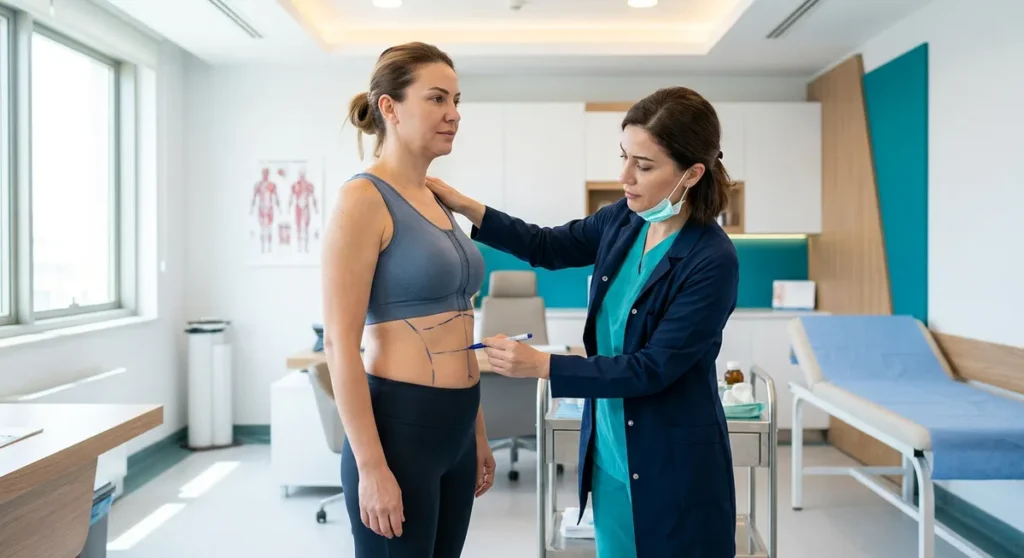
Four main breast surgery types are performed at Santé in Istanbul: augmentation with implants, breast lift (mastopexy), reduction, and combination augmentation-with-lift procedures.
Breast augmentation
The most common procedure we arrange. Silicone implants are placed either under the muscle (submuscular) or over it (subglandular), depending on your body type and the look you want.
Breast lift (mastopexy)
A lift doesn’t add volume. It reshapes and repositions the breast tissue you already have. Three techniques exist – periareolar (mild sagging), vertical/lollipop (moderate), and anchor/inverted-T (significant sagging).
Let me be honest: a lift involves more visible scarring than augmentation. Scars fade over 12–18 months, but they don’t disappear completely.
Breast reduction
Removes excess tissue, fat, and skin. One of the highest satisfaction procedures in plastic surgery.
But it can affect your ability to breastfeed. If that matters to you, tell your surgeon upfront.
Augmentation + lift combination
Lost volume after pregnancy or weight loss, and your breasts have dropped? You probably need both. Many patients also combine breast work with a tummy tuck or liposuction in the same trip. See our body contouring page for combination options.
What Does the Surgery and Recovery Process Look Like?
The full process takes 8–10 days in Istanbul. Surgery itself lasts 1–3 hours depending on the procedure, and most patients are walking comfortably within 24 hours.
Before you fly (2–4 weeks before): Video consultation with your surgeon. We review your medical history, discuss your goals, and your surgeon recommends the right procedure, implant type, and placement.
Days 1–2 in Istanbul: You land, we pick you up. Hotel check-in. Day 2 is your in-person consultation: blood work, measurements, final planning.
Day 3 – surgery day: You’re at the hospital by 7 AM. Surgery takes 1–3 hours under general anaesthesia. You wake up in a private room with your compression bra already on. One night in hospital for monitoring.
Days 4–7 – early recovery: Back at the hotel. You’ll feel tight and sore. Short walks are encouraged. We check your dressings, answer questions, and make sure you’re healing as expected.
Days 8–10 – heading home: Final check-up with your surgeon. Then we drive you to Istanbul Airport.
Weeks 2–6 at home: One week off work minimum. No heavy lifting for 4–6 weeks. No gym for 6 weeks. Your breasts will “drop and fluff” over 3–6 months.
The part nobody talks about: the first week at home can feel isolating. That’s why we schedule three follow-up video consultations – at 1 week, 4 weeks, and 3 months after your surgery. If something feels wrong at 2 AM, you also have your surgeon’s WhatsApp.
How Do We Choose Your Surgeon?
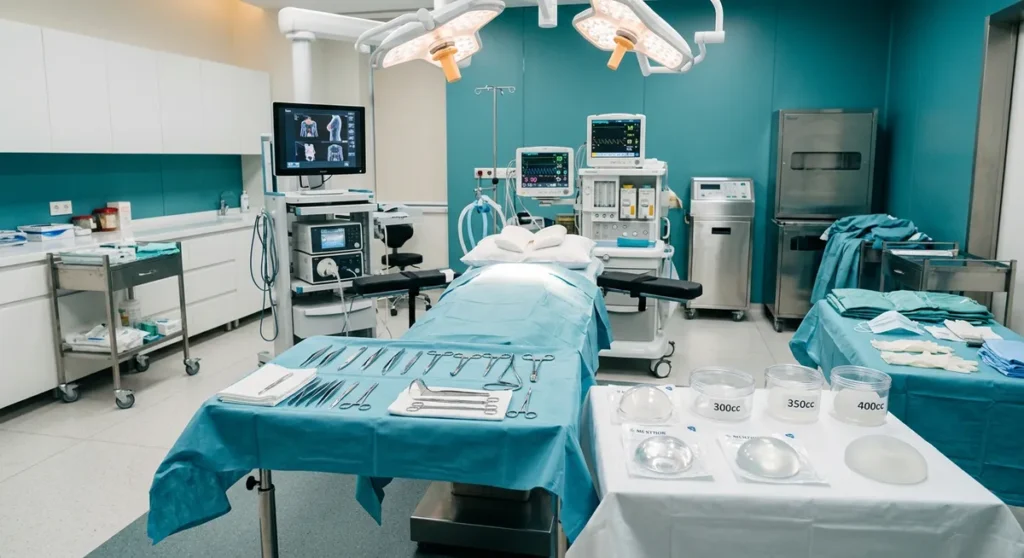
Every surgeon we work with is board-certified in plastic and reconstructive surgery by the Turkish Board of Plastic Surgery and operates in JCI-accredited hospitals.
After five years living in Istanbul, I’ve learned something about how Turkish plastic surgery works: most surgeons work in 3–4 different clinics or hospitals. This means you aren’t really choosing a clinic. You’re choosing a surgeon.
We don’t rotate surgeons based on availability. We match you with a specific surgeon based on the procedure you need and that surgeon’s particular strengths.
You’ll have a video call with your actual surgeon before you book anything. Not a sales consultant. Not an “advisor.” The person who will be in the operating room.
Is Breast Surgery in Turkey Safe?
Breast surgery in Turkey is safe when performed by a board-certified plastic surgeon in a JCI-accredited hospital. Turkey performed over 1.2 million cosmetic procedures in 2024, making it one of the highest-volume countries worldwide according to ISAPS.
But let me be honest about the risks, because they exist regardless of which country you choose.
Capsular contracture affects 3–5% of breast augmentation patients.
Implant rupture occurs in fewer than 1% of patients within the first 10 years.
Infection, bleeding, asymmetry, changes in nipple sensation – all possible. The risk is low but it isn’t zero.
The medical tourism-specific risk: what if something goes wrong after you fly home? Your surgeon is available by WhatsApp. You get three scheduled follow-up video consultations. And if you need a revision within the first year, we cover the surgical costs – you only pay for travel.
Who should NOT get breast surgery right now: – If you’re planning to get pregnant in the next 12 months – If you’re currently losing weight and haven’t stabilised – If you smoke and aren’t willing to quit 4 weeks before and after surgery – If your expectations are based on heavily filtered photos
For reference, a 2023 study published on PubMed (PMID: 36917408) found that complication rates for breast augmentation in Turkey were comparable to those reported in US and European studies. The FDA’s breast implant safety page provides a thorough overview of long-term implant risks.
What Implant Brands and Types Are Used?
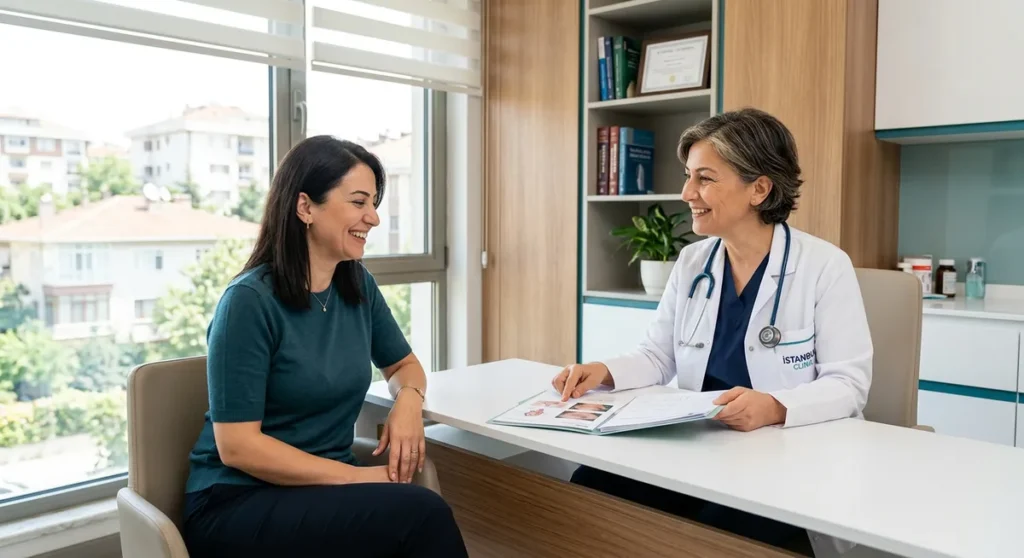
We use three implant brands: Mentor (by Johnson & Johnson), Motiva, and Allergan Natrelle. All FDA-approved and CE-marked.
Round vs anatomical (teardrop) implants
Round implants are the most popular worldwide. They give more fullness in the upper breast.
Anatomical (teardrop) implants mimic the natural breast shape with more volume at the bottom.
For most patients, round implants under the muscle produce a natural result.
Under vs over the muscle
Submuscular (under): More natural look, better mammogram readings, lower capsular contracture rates. But recovery is more painful.
Subglandular (over): Shorter recovery, works well for patients with enough natural tissue.
A detailed facial and body analysis during your consultation helps determine the right implant for your body.
What Can Go Wrong – and How Do We Handle It?
Things can go wrong with any surgery, in any country.
Early complications (first 2 weeks): Actual complications like infection (under 2%), haematoma (1–2%), or wound separation are handled immediately at no extra cost.
Late complications (months to years): Capsular contracture (3–5%), implant malposition, rippling, or size dissatisfaction may require revision.
Our revision policy: if you need a surgical revision within 12 months due to a complication, we cover the surgeon’s fee and hospital costs. You pay only for flights and accommodation.
What Real Patients Ask Us (FAQ)
How long do breast implants last? Modern silicone implants are designed to last 10–15 years. Some patients go 20 years without issues.
Will I lose nipple sensation? Temporary numbness is common. Permanent loss occurs in roughly 5–10% of patients.
Can I breastfeed after augmentation? Most women can. Submuscular placement and inframammary incisions have the least impact on milk ducts.
How soon can I fly home after surgery? We recommend staying 7–10 days. Your surgeon clears you for travel at your final check-up.
Can I combine breast surgery with other procedures? Yes. Many patients combine breast work with a tummy tuck or liposuction.
What size implant should I choose? Don’t choose a cup size. Your surgeon will recommend a volume in cubic centimeters (cc) based on your measurements.
How do I know Santé is legit? See our Trustpilot page. Ask us for contact details of past patients willing to share their experience.
Do you offer financing or payment plans? We accept payment in stages: a deposit to secure your date, and the balance before surgery.
Ready to Get a Real Quote?
Not a ballpark. Not a “starting from” number. A real quote, specific to your procedure, your implant choice, and your travel dates.
Here’s how it works: you message us on WhatsApp or fill out the contact form. My partner responds personally – usually within a few hours. Then we arrange a free video consultation with your surgeon.
No pressure. No “limited time offers.” No sales tricks.
WhatsApp: +90 546 229 38 34 Contact form: Click here See our full price list: Prices
After five years living in Istanbul and working alongside dozens of surgeons, I can tell you the best outcomes come from patients who do their research, ask hard questions, and don’t rush. You’re already doing the first two. Take your time with the third.
Last updated: March 2026
FAQ
Can't find what you're looking for?
Contact us
or message us
Quick answers to questions
you may have
Your Most Important Questions, Answered
How do I choose between silicone and saline implants?
Silicone implants feel more natural and are less likely to ripple, making them the most popular choice. Saline implants can be adjusted during surgery and would safely deflate if ruptured. Modern silicone is very safe with cohesive gel that doesn’t leak. Your surgeon will recommend based on your anatomy, lifestyle, and preferences. Most patients choose silicone.
Will I lose nipple sensation after breast surgery?
Temporary numbness is common, but permanent sensation loss is rare (less than 5%). Most patients regain normal sensation within 3-6 months. Certain techniques and incision locations have lower risk. Skilled surgeons use nerve-preserving techniques to minimize this risk. The periareolar incision has slightly higher risk than inframammary.
How long do breast implants last?
Modern implants don’t have an expiration date but aren’t considered lifetime devices. Average lifespan is 10-20 years, though many last longer. You don’t need to replace them unless there’s a problem. Regular monitoring with MRI or ultrasound (every few years) is recommended. Turkish clinics offer affordable implant replacement packages.
Can I breastfeed after breast augmentation?
Most women can breastfeed successfully after augmentation. The periareolar incision has slightly higher risk of affecting milk ducts. Implants placed under the muscle interfere less with breast tissue. Discuss your plans with your surgeon for optimal technique selection. Many mothers have successfully nursed after implants.
What is capsular contracture and how is it prevented?
Capsular contracture occurs when scar tissue around the implant tightens, causing firmness or distortion (5-10% risk). Prevention includes: proper surgical technique, textured or polyurethane implants, submuscular placement, antibiotics, and possibly leukotriene inhibitors. Turkish surgeons use advanced “no-touch” techniques that significantly reduce risk.
Is it safe to have breast surgery abroad?
Yes, when choosing accredited facilities and qualified surgeons. Turkish hospitals meet international standards (JCI accreditation). The same implants and techniques are used as in Western countries. full packages include aftercare. Many surgeons trained internationally. The key is proper research and choosing reputable providers.
What if I need revision surgery later?
Reputable Turkish surgeons offer revision policies covering surgical fees for complications within the first year. For aesthetic revisions or future implant replacement, they offer returning patient discounts. Many UK/EU surgeons will provide follow-up care. Keep all documentation for continuity of care. The savings on initial surgery often cover potential future revision costs.
Why our prices say «from»
Every figure on this page is a starting price for one confirmed, specific option — not an average and not a package. What changes the final number:
- the area treated and the volume of work
- the technique the surgeon chooses after seeing your case
- whether the procedure is combined with another one in the same session
- implants or materials, where the case needs them
The final amount is confirmed by the doctor after a panoramic X-ray or an in-person assessment — until then any figure, including ours, is an estimate. We quote from a single confirmed price list, so the number you hear on WhatsApp is the same one you see here. If you are already in Istanbul, the consultation and the X-ray are free.