Endoscopic face lift in Turkey, priced after consultation. Minimal scarring, faster recovery than traditional facelift. Santé Istanbul.
How Much Does an Endoscopic Lift Cost in Turkey in 2026?
In Istanbul the price of an endoscopic face lift is set by the surgeon after a consultation; in the UK it costs €8,000–15,000 and in the USA $10,000–18,000. The procedure is less invasive than a traditional facelift, uses smaller incisions (3–5 tiny cuts hidden in the hairline), and involves a camera-guided approach to lift the brow and midface.
This isn’t a facelift replacement. It’s a specific technique that works for a specific group of patients – typically those in their 40s–50s with early to moderate sagging, particularly in the brow and midface area. If you have significant jowling or neck laxity, you need a traditional facelift, not an endoscopic lift.
| Procedure | Turkey (2026) | UK | Germany | USA |
|---|---|---|---|---|
| Endoscopic Brow Lift | Quoted after consultation | €5,000–9,000 | €4,000–7,000 | $6,000–10,000 |
| Endoscopic Midface Lift | Quoted after consultation | €7,000–12,000 | €6,000–10,000 | $8,000–15,000 |
| Endoscopic Full Face | Quoted after consultation | €8,000–15,000 | €7,000–12,000 | $10,000–18,000 |
How Is an Endoscopic Lift Different from a Traditional Facelift?
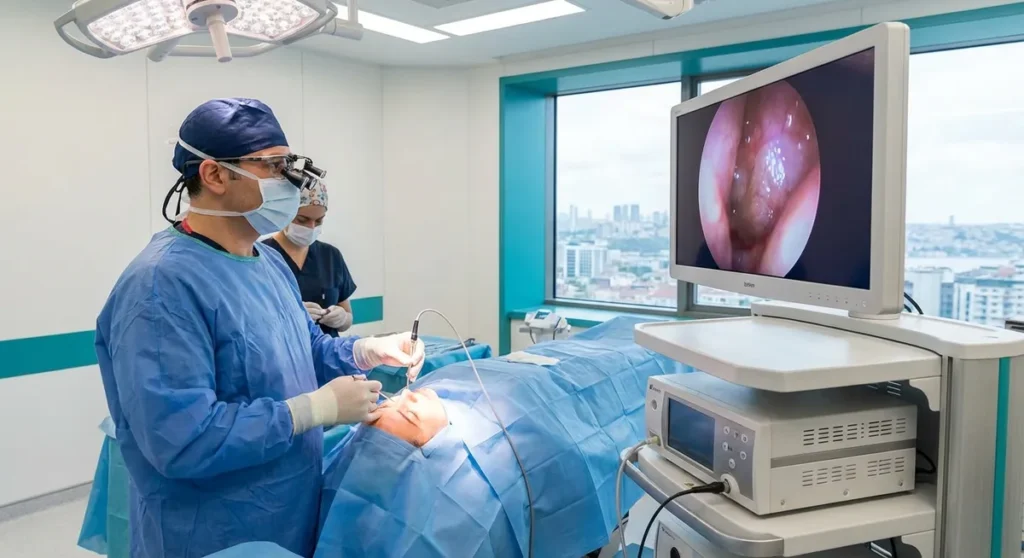
An endoscopic lift uses a thin camera (endoscope) inserted through 3–5 small incisions in the scalp. The surgeon views the tissue on a monitor and repositions it with specialized instruments. A traditional facelift uses longer incisions along the hairline and in front of the ears to directly access and reposition the SMAS layer.
What endoscopic lifts do well: – Lift heavy or drooping brows – Smooth horizontal forehead lines – Raise the midface to reduce nasolabial folds – Correct under-eye hollowing by repositioning fat pads
What they don’t do: – Address significant jowling (lower face sagging) – Fix turkey neck or platysmal banding – Remove excess skin (there are no large incisions to trim skin)
The advantage is recovery. Smaller incisions mean less bruising, less swelling, and faster healing – most patients look presentable in 7–10 days versus 14+ for a traditional facelift. Scarring is virtually invisible since the incisions are tiny and hidden in hair.
I personally recommend endoscopic lifts for patients whose main concerns are heavy brows and midface descent. If the problem is concentrated above the jawline, this technique gives excellent results with less downtime. But if you have jowls, loose neck skin, or significant lower face sagging, I’ll tell you this approach won’t be enough.
What Does the Surgery and Recovery Look Like?
Surgery takes 1.5–3 hours under general anesthesia. Most patients go home from the hospital the same day or stay one night.
Day 1–3. Moderate swelling around the forehead and eyes. Compression bandage for 48 hours. Mild headache is common (from tissue repositioning near the periosteum). Pain is manageable – most patients describe it as pressure rather than sharp pain.
Day 4–7. Sutures or small screws (used to secure tissue in its new position) are removed. Bruising fades. You can wash your hair gently.
Day 7–10. Most patients are cleared to fly. Swelling is still present but not obvious. You look “refreshed,” not like you had surgery.
Weeks 2–6. Gradual improvement. Residual numbness in the forehead resolves. Full activities resume at week 4–6.
Month 3. Final results visible.
My partner manages your pre-op and post-op appointments in Istanbul and coordinates 3 video follow-ups after you return home.
Can I Combine an Endoscopic Lift with Other Procedures?
Yes, and this is where the endoscopic approach really shines. Because it’s less traumatic than a full facelift, it combines well with other procedures without overwhelming the recovery.
- Endoscopic lift + Upper blepharoplasty – heavy brows plus hooded eyelids. The most common combination.
- Endoscopic lift + Cat eye surgery – lifts the brow and outer eye simultaneously.
- Endoscopic lift + Facelift – for patients who need both upper and lower face rejuvenation. The endoscopic component handles the brow while the facelift addresses jowls and neck.
- Endoscopic lift + Skin rejuvenation – PRP or laser during recovery to improve overall skin quality.
What Real Patients Ask Us (FAQ)
“Am I too young for an endoscopic lift?” If you have heavy brows or a low brow position that’s genetic (not just aging), endoscopic brow lift can help at any adult age. Most patients are 40–55, but we’ve worked with patients in their 30s who had congenital brow ptosis.
“How long do results last?” 7–12 years for the brow lift, somewhat less for midface repositioning. Results are long-lasting because the tissue is fixed in a new position, not just tightened.
“Will it change my facial expressions?” Not if done well. The goal is to restore a more youthful brow position, not freeze your forehead. You should still be able to raise your eyebrows and express emotions naturally.
“Is it better than Botox for forehead lines?” Different solutions. Botox relaxes muscles that create dynamic lines (when you move your face). An endoscopic lift repositions tissue that has physically descended. Many patients continue using Botox after surgery for optimal results.
Ready to Get a Real Quote?
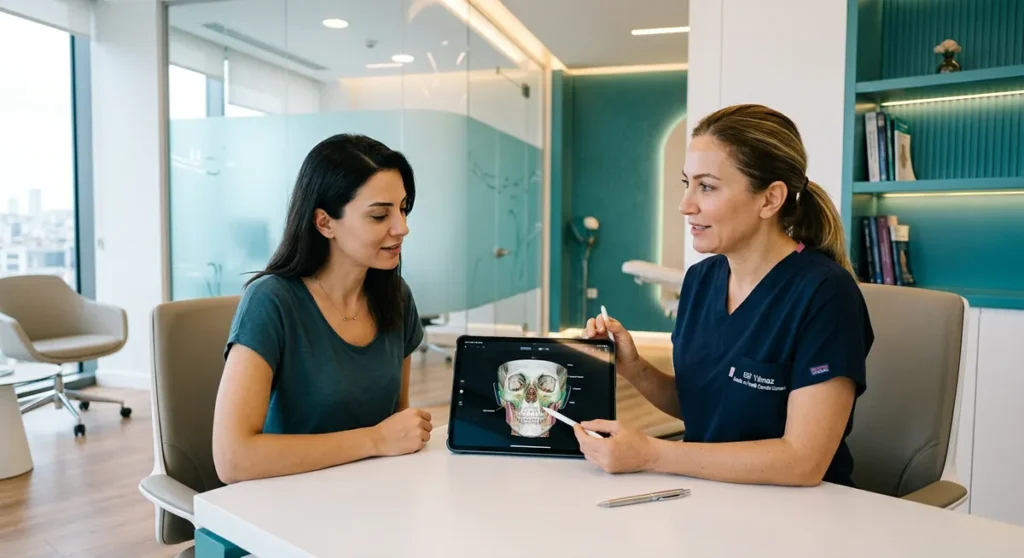
Send us front and profile photos on WhatsApp. Our surgeon will assess whether an endoscopic lift, traditional facelift, or another approach best suits your anatomy.
WhatsApp: +90 546 229 38 34
Or fill out the contact form.
FAQ
Can't find what you're looking for?
Contact us
or message us
Quick answers to questions
you may have
Your Most Important Questions, Answered
How long do endoscopic facelift results really last?
Endoscopic facelift results typically last 8-12 years, similar to traditional facelift surgery. The brow lift component often lasts longest (10-15 years), while midface results may soften after 7-10 years. Longevity depends on skin quality, lifestyle factors (especially sun exposure and smoking), and genetic aging patterns. You’ll always look younger than if you hadn’t had surgery. Maintain results with skin rejuvenation treatments and ensure your aesthetic dentistry keeps pace with your rejuvenated face.
Can endoscopic facelift address neck sagging?
Endoscopic technique has limitations for neck rejuvenation. While it can provide mild improvement through platysma muscle tightening accessed via small incisions, it cannot remove excess neck skin. Patients with significant neck laxity need traditional neck lift surgery techniques. Many surgeons combine endoscopic upper/midface work with traditional neck lift for detailed results. Your facial analysis will determine the best approach.
Is endoscopic facelift less risky than traditional?
Endoscopic facelift generally has lower risk of certain complications like skin necrosis, major nerve injury, and hematoma due to less tissue trauma. However, it requires specialized expertise – an inexperienced surgeon may have higher complication rates than with traditional techniques they know well. Choose based on surgeon experience with the specific technique, not just the technique itself. Turkish surgeons’ high volume (15-20 monthly) provides exceptional safety.
Will I need drains with endoscopic facelift?
Most endoscopic facelifts don’t require drains because there’s less tissue undermining and bleeding. The minimal dissection means fluid accumulation is rare. This is another recovery advantage – no drain management or removal appointments needed. Some surgeons use tiny drains for 24 hours if combining with other procedures like neck lift or extensive fat grafting.
Can endoscopic facelift be revised if needed?
Revision is possible but can be more challenging than revising traditional facelifts due to scarring around the fixation points. However, experienced endoscopic surgeons can perform revisions successfully. Sometimes revision requires converting to traditional technique. This is why choosing an experienced surgeon initially is crucial. After 8-12 years, you might need touch-up with mini-lift or skin rejuvenation treatments.
Is endoscopic facelift suitable for men?
Endoscopic facelift is actually ideal for men because scars are completely hidden in the hairline – no visible incisions around ears that might be noticeable with short hair. The technique preserves masculine features while providing natural rejuvenation. Many male patients combine with FUE hair transplant planning, hair loss treatment consultation, and teeth whitening for complete transformation without obvious surgery signs.
How soon can I exercise after endoscopic facelift?
Light walking can begin day 2-3. Gentle stretching and light cardio (keeping heart rate under 100) usually allowed by week 2. Full exercise including weight training typically cleared by week 4. This is significantly faster than traditional facelift recovery. The minimal tissue trauma means less risk from increased blood pressure during exercise. Many patients schedule dental consultations during week 2 when mobile but not yet exercising.
Can I combine endoscopic lift with dental work?
Absolutely! Days 5-8 of recovery are perfect for dental implants consultations, teeth whitening, and aesthetic dentistry planning. You’re comfortable but not yet traveling, making it ideal timing. Many patients complete veneer impressions and shade selection during this period. Turkish clinics excel at coordinating between departments, offering package deals saving 20-30% versus separate trips.
Why our prices say «from»
Every figure on this page is a starting price for one confirmed, specific option — not an average and not a package. What changes the final number:
- the area treated and the volume of work
- the technique the surgeon chooses after seeing your case
- whether the procedure is combined with another one in the same session
- implants or materials, where the case needs them
The final amount is confirmed by the doctor after a panoramic X-ray or an in-person assessment — until then any figure, including ours, is an estimate. We quote from a single confirmed price list, so the number you hear on WhatsApp is the same one you see here. If you are already in Istanbul, the consultation and the X-ray are free.