
Hair Loss Therapy in Turkey: Prices, Options, and What Nobody Tells You (2026)
Hair loss treatment in Turkey. PRP, mesotherapy, medications, transplant. Honest guide to what works in 2026. Find the right treatment for your stage. Sante Clinic.
Table of Contents
Get free quote
What Are My Hair Loss Treatment Options in Turkey?
Hair loss treatment in Istanbul ranges from non-surgical therapies starting at €100 per session to surgical FUE hair transplant at €1,500–3,000. The right approach depends entirely on your stage of loss, cause, age, and expectations. There is no single treatment that works for everyone.
This page is a decision guide. If you already know what you need, go directly to FUE transplant, PRP therapy, or mesotherapy. If you’re not sure, read on – I’ll break down what works at each stage so you can make an informed decision.
What Causes Hair Loss?
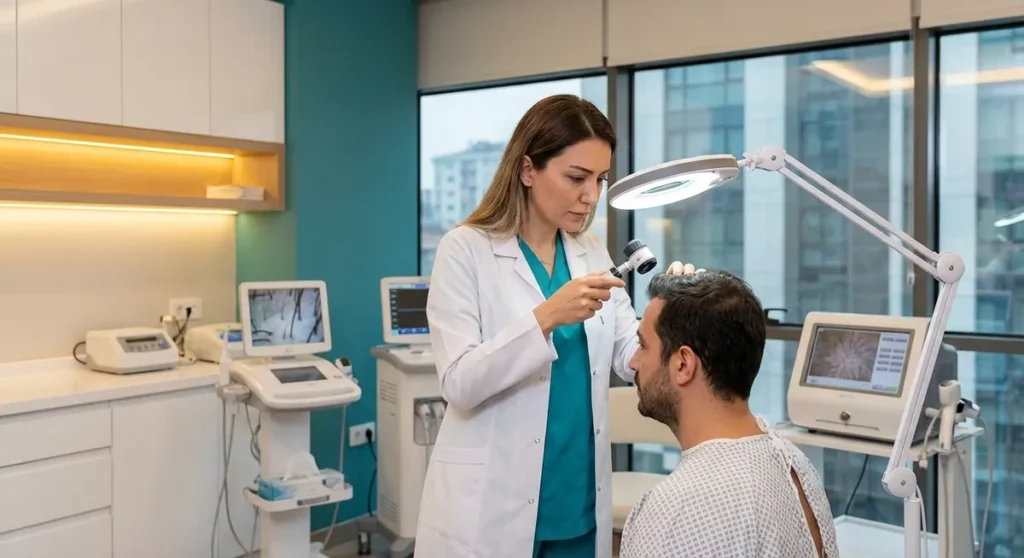
Understanding the cause determines the treatment. Getting this wrong means wasting money on a treatment that won’t help.
Androgenetic alopecia (genetic pattern baldness). The most common cause – 70% of men and 40% of women experience it. Hormone-driven miniaturization of hair follicles. Progressive, predictable pattern (Norwood scale for men, Ludwig scale for women). All treatments on this page target this condition.
Telogen effluvium. Temporary excessive shedding triggered by stress, illness, surgery, crash dieting, or hormonal changes (postpartum, thyroid disorders). Hair typically recovers on its own within 6–12 months once the trigger is removed. Treatment: address the underlying cause. PRP or mesotherapy can help accelerate recovery.
Alopecia areata. Autoimmune condition causing patchy hair loss. Unpredictable, can resolve spontaneously or progress. Treatment options exist (corticosteroids, JAK inhibitors), but hair transplant is NOT recommended for active alopecia areata – the immune system can attack transplanted hair too.
Traction alopecia. Hair loss from chronic pulling (tight hairstyles, extensions). Reversible if caught early. Irreversible if follicles have scarred over.
Medical causes. Iron deficiency, thyroid disorders, medications, autoimmune conditions. Treat the medical cause first. Cosmetic treatments won’t help if the underlying condition persists.
Which Treatment Works at Which Stage?
Here’s an honest breakdown by Norwood stage (men) and Ludwig stage (women):
Early thinning (Norwood 2–3 / Ludwig I): – First line: finasteride (oral, 1mg daily) + minoxidil (topical, 5%) – Add-on: PRP therapy (3 sessions, then maintenance) – Add-on: Hair mesotherapy (if PRP alone isn’t sufficient) – Transplant: not yet necessary in most cases
Moderate loss (Norwood 3–4 / Ludwig II): – Medications continue (finasteride + minoxidil) – PRP and mesotherapy help strengthen remaining hair – FUE hair transplant becomes viable – 1,500–3,000 grafts typical – Best outcomes combine transplant + ongoing medication + PRP maintenance
Advanced loss (Norwood 5–7 / Ludwig III): – Transplant is the primary option – 3,000–5,000+ grafts – Donor area (back and sides of head) may limit how much can be transplanted – Medications and PRP maintain whatever native hair remains – Be realistic: a transplant can improve density significantly but may not achieve full coverage at very advanced stages
What About Medications?

Finasteride (Propecia). The most effective medical treatment for male pattern baldness. Blocks DHT, the hormone that shrinks follicles. 1mg daily. Takes 3–6 months to show results. Side effects (sexual) affect 2–3% of users and are reversible upon stopping. I recommend discussing this with your doctor before starting.
Minoxidil (Rogaine). Topical vasodilator that stimulates follicle activity. Available over the counter (5% for men, 2% for women). Apply twice daily to the scalp. Works best in the crown area. Results take 4–6 months.
Dutasteride. Stronger than finasteride (blocks both types of 5-alpha reductase). Used off-label in some countries for hair loss. More effective but potentially more side effects. Some dermatologists in Istanbul prescribe it for patients who don’t respond to finasteride.
Topical finasteride. Applied directly to the scalp rather than taken orally. Lower systemic absorption means potentially fewer side effects. Available at some clinics in Istanbul.
These medications are not expensive – finasteride costs €10–30 per month, minoxidil €15–30. You don’t need to come to Turkey for prescriptions. Any dermatologist can prescribe them.
How Do I Know If I Need a Transplant or Just Therapy?
This is the question I hear most from hair loss patients. Here’s how we help you decide.
You probably DON’T need a transplant if: – Your hair loss is recent (under 2 years) and you haven’t tried medications yet – You have diffuse thinning without clear bald areas – Your loss is caused by stress, diet, or a medical condition that’s treatable – You’re under 25 (hair loss pattern may not be established yet – transplanting too early risks needing more work later)
You probably DO need a transplant if: – Medications have been tried for 12+ months with insufficient results – You have visible bald areas that bother you – Your hair loss pattern is established and stable – You have adequate donor hair (back and sides of the head)
When we’re unsure: we start with PRP + medication for 6 months and reassess. If native hair strengthens enough, no transplant needed. If not, we’ve preserved what’s there while planning the surgical approach.
Send us photos and we’ll give you an honest assessment. We’d rather tell you “try finasteride for a year first” than sell you a transplant you don’t need yet.
What Are the Costs for Different Approaches?
| Treatment | Turkey (2026) | UK | What It Does |
|---|---|---|---|
| Finasteride (monthly) | €10–30 | €20–50 | Blocks DHT, maintains hair |
| Minoxidil (monthly) | €15–30 | €20–40 | Stimulates growth topically |
| PRP (3-session course) | €400–800 | €1,200–2,400 | Growth factor stimulation |
| Mesotherapy (4 sessions) | €350–800 | €1,000–2,000 | Nutrient delivery to follicles |
| FUE Transplant (2,000 grafts) | €1,500–2,500 | €5,000–8,000 | Permanent graft relocation |
| FUE Transplant (4,000 grafts) | €2,000–3,000 | €8,000–12,000 | Extensive coverage |
What Real Patients Ask Us (FAQ)
“Can hair loss be stopped completely?” Slowed, yes. Stopped entirely, rarely. Finasteride reduces loss by 80–90% in responders. PRP helps maintain thickness. But genetic hair loss is progressive – treatment manages the progression rather than curing it.
“At what age should I start treatment?” As soon as you notice thinning. Earlier intervention preserves more hair. If you’re in your 20s and seeing miniaturized hair (thin, short, light-colored hairs where you used to have thick ones), that’s the time to start finasteride and minoxidil.
“Is a hair transplant permanent?” The transplanted hair is permanent – it comes from the “permanent zone” (back and sides) that isn’t affected by DHT. But your non-transplanted hair continues thinning without medication. This is why we recommend finasteride after transplant: to maintain the native hair surrounding the grafts.
“Do women benefit from PRP/mesotherapy?” Yes, often more than men. Female pattern hair loss involves diffuse thinning with more active follicles that respond well to stimulation. PRP and mesotherapy are frequently first-line treatments for women before considering transplant.
Ready to Get a Real Assessment?
Send us photos of your hair on WhatsApp – top of head, hairline, crown, and both sides. We’ll assess your stage, identify the likely cause, and recommend the right treatment path. No upselling.
WhatsApp: +90 545 910 44 03
Or fill out the contact form.
Quick answers to questions
you may have
Your Most Important Questions, Answered
How long do I need to take hair loss medications?
Hair loss medications require indefinite use to maintain results. Stopping treatment typically leads to resuming hair loss within 3-6 months. Think of it like managing any chronic condition – diabetes, hypertension – requiring ongoing treatment. However, protocols can be adjusted over time, and some patients can reduce doses once stability achieved.
What's the success rate of medical hair loss therapy?
Combination therapy achieves 85-90% response rate, with 65% seeing regrowth and 20-25% maintaining current hair. Finasteride alone shows 85% success in stopping progression, 65% in regrowth. Results vary based on age, degree of loss, and treatment compliance. Early intervention dramatically improves outcomes.
Are hair loss medications safe long-term?
FDA-approved medications like finasteride and minoxidil have 20+ years of safety data. Millions use them safely long-term. Side effects affect 2-4% of users and are usually reversible. Regular monitoring ensures safety. Turkish clinics excel at managing any issues that arise. Benefits typically outweigh risks for appropriate candidates.
Can women use the same medications as men?
No, women cannot use finasteride or dutasteride if pregnancy possible (severe birth defect risk). Women typically use minoxidil, spironolactone, and hormone optimization. Post-menopausal women have more options. Female protocols differ significantly and require specialized approach Turkish clinics provide.
When will I see results from medical therapy?
Initial stabilization occurs at 2-3 months with decreased shedding. Visible improvement starts at 4-6 months. Significant results appear at 9-12 months. Maximum benefit reached at 18-24 months. Some experience initial shedding (good sign) before improvement. Patience essential for success.
Can I stop medications after hair regrows?
No, discontinuing medications causes loss of gained hair within 3-6 months. Hair follicles need continuous protection from DHT and ongoing stimulation. Some patients can reduce doses or frequency once stable, but complete cessation leads to regression. Consider it maintenance therapy for a chronic condition.
What if oral medications cause side effects?
Multiple alternatives exist: topical finasteride (fewer systemic effects), different medications (dutasteride vs finasteride), dose adjustments (every other day), combination topical formulas, or non-medication approaches (PRP, mesotherapy). Turkish clinics specialize in finding tolerable, effective protocols for each patient.