Veneers in Turkey from €240/tooth. E-max, laminate, minimal-prep options. Real prices March 2026. Day-by-day treatment guide + honest TikTok teeth breakdown.
How Much Do Veneers Cost in Turkey in 2026?
A single E-max veneer in Istanbul costs from €240 as of March 2026, compared to £500–1,000 in the UK and $800–2,000 in the USA. A full set of 20 veneers runs from €3,400 at Santé, including digital smile design, temporary veneers, hotel, and airport transfers.
Those numbers hit differently when you’ve been quoted £12,000 for 10 veneers in London. I hear it weekly on WhatsApp calls: “Is this real? What’s the catch?”
There’s no catch. The IPS e.max porcelain blocks are manufactured by Ivoclar in Liechtenstein – same blocks shipped to clinics in the UK, Germany, and the US. Turkish dental labs buy them from the same distributor. What changes is rent, staff costs, and malpractice insurance. A dental office in Sisli, Istanbul pays roughly one-fifth the overhead of a practice on Harley Street.
Here’s the breakdown:
| Treatment | Turkey (2026) | UK | Germany | USA | You Save |
|---|---|---|---|---|---|
| E-max Veneer (per unit) | from €240 | £500–1,000 | €400–900 | $800–2,000 | 65–80% |
| Full Set Veneers (20) | from €3,400 | £10,000–20,000 | €8,000–18,000 | $16,000–40,000 | 65–80% |
| Laminate Veneer (per unit) | from €240 | £600–1,200 | €500–1,000 | $1,000–2,500 | 60–75% |
“What if I only need 8 veneers, not 20?” Good – that means your dentist isn’t pushing you into work you don’t need. Most of our patients get 8–12 veneers covering the visible smile zone. We price by the tooth, not by the package. Your quote reflects exactly what your case needs.
And if your teeth are mostly fine with minor discoloration or small chips, we’ll tell you. Sometimes teeth whitening or composite bonding does the job for a fraction of the cost. Not every smile needs porcelain.
What Types of Veneers Are Available?
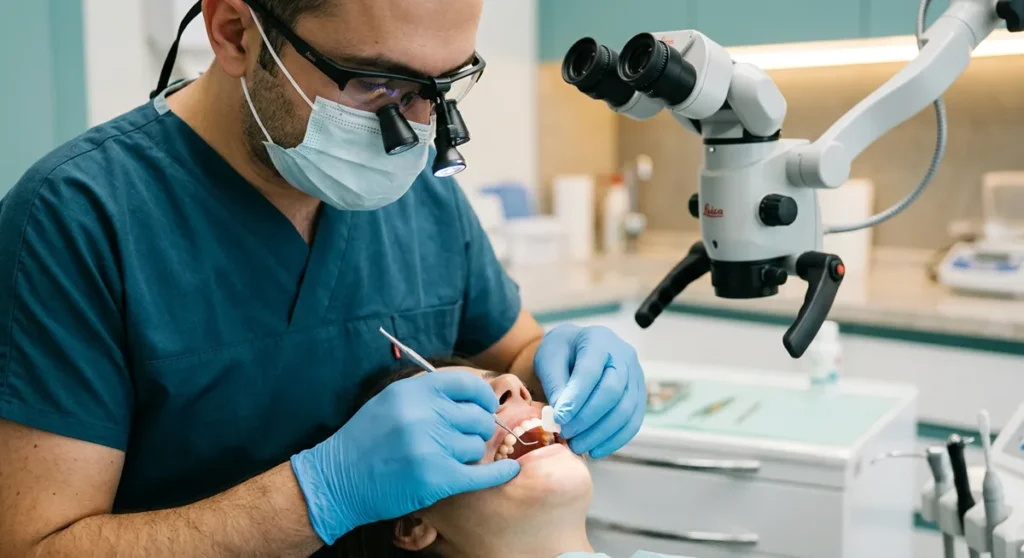
Three main types dominate the market in 2026: IPS e.max porcelain veneers, laminate veneers, and composite veneers. Each involves different levels of tooth preparation, and the right choice depends on your teeth’s current condition, not on what looks best on Instagram.
IPS e.max veneers are the gold standard. Made from lithium disilicate ceramic by Ivoclar, they’re strong enough for both front and side teeth, translucent enough to look natural, and last 10–15 years with proper care. A 2019 study in the Journal of Prosthetic Dentistry reported a 93.5% survival rate for lithium disilicate veneers at 10 years. This is what we recommend for most patients.
Laminate veneers are thinner – 0.2–0.5mm – and require minimal or zero tooth reduction. They work best when you’re happy with your tooth alignment but want to correct color, close small gaps, or smooth edges. Think of them as contact lenses for teeth.
Composite veneers are the budget option. Applied directly in the chair, no lab work, done in a single visit. They cost less but last 5–7 years instead of 10–15, and they stain more easily. For patients on a tight budget or wanting to test-drive a new look before committing to porcelain, composites make sense. For everyone else, E-max.
Lumineers vs. veneers: Lumineers are a branded ultra-thin veneer (0.2mm) marketed as “no-prep.” They work in specific cases – minor color correction, small gap closure. But they can look bulky on teeth that aren’t naturally thin. Our doctors will tell you if Lumineers suit your bite. Often they don’t.
What About Those TikTok 'Turkish Teeth' Videos?
You’ve seen them. Teeth filed down to tiny stumps, gums bleeding, final result looking unnaturally white and blocky. Those videos are real – and they represent the worst of dental tourism. But they show one specific technique taken to its extreme, not what competent clinics actually do.
“Those viral videos of teeth filed to stumps? That’s full veneer preparation. 80% of the time our doctors use minimal-prep – 0.3–0.5mm removed vs 1.5–2mm. The difference is in the clinic, not the country.”
Here’s the technical reality. Full-prep veneers remove 1.5–2mm of tooth enamel. That’s what you see in the scary TikTok clips. It’s aggressive, and once it’s done, there’s no going back – those teeth will always need crowns or veneers from that point on.
Minimal-prep veneers remove 0.3–0.5mm. That’s less than the thickness of a credit card. Your natural tooth structure stays mostly intact. If a veneer chips in 12 years, your dentist replaces it – but the tooth underneath is still healthy.
So why do some clinics still do full-prep? Speed and margin. Aggressive preparation is faster, requires less precision, and hides more underlying issues. A clinic processing 15 patients a day doesn’t have time for minimal-prep technique.
Our partner clinics in Istanbul take 4–6 patients per day. Each veneer case gets a full digital scan, a wax-up preview, and careful preparation. The reason we limit volume: your dentist needs time to get the margins right. Rushed prep is how you end up on TikTok for the wrong reasons.
What Does the Treatment Process Look Like Day by Day?
A full veneer treatment in Istanbul takes 5–7 days in a single visit. Unlike implants, there’s no healing period requiring a second trip. You fly in, get your smile, fly home.
Before you fly: You send us photos and a panoramic X-ray via WhatsApp. The dentist reviews your case remotely, and you receive a preliminary treatment plan with price, veneer count, and type recommendation. We also run a digital smile design – a 3D model showing your expected result before any work begins.
Day 1 – Arrival and consultation. Our driver meets you at Istanbul Airport. Hotel check-in (Sisli or Besiktas – both central, walkable neighborhoods close to the clinic). Afternoon: in-person examination, 3D scan, shade selection, and treatment confirmation. My partner is at this appointment. She translates everything, confirms the plan, and makes sure you and the dentist agree on the shade and shape.
Shade selection matters more than people realize. You’ll look at shade guides under natural light, not just clinic fluorescents. Our dentists default to a natural white – bright enough to notice the difference, natural enough that nobody asks “are those veneers?”
Day 2 – Preparation. The dentist prepares your teeth (minimal-prep in most cases). Digital impressions go to the lab. You leave with temporary veneers – they’re not gorgeous, but they’re functional. You can eat, talk, and smile without gaps.
Days 3–4 – Lab work. Your E-max veneers are milled and layered at the dental lab. This takes 24–48 hours. Meanwhile, you’re free. Walk through the Grand Bazaar. Take the ferry to the Asian side. Eat fish sandwiches at Eminonu. Istanbul is a spectacular city and you have time to enjoy it.
Day 5 – Trial fitting. Veneers are placed temporarily so you can see the result. Check the color, shape, and bite. If something’s off – a veneer is too long, too square, too opaque – it goes back to the lab. This step is non-negotiable at our clinics.
Day 6 – Final bonding. Once you approve, the veneers are permanently bonded. Bite adjustment, polish, final photos.
Day 7 – Check-up and departure. Morning check, aftercare instructions, and you fly home with your new smile. Total time from landing to leaving: about a week.
Are Veneers in Turkey Safe?
Veneers placed by qualified dentists using branded materials like IPS e.max carry the same success and longevity rates regardless of country. The risk isn’t geography – it’s clinic selection. Turkey’s dental tourism industry includes both excellent clinics and corner-cutting operations, and telling them apart requires insider knowledge.
Here’s what I’ve learned living in Istanbul for five years: dentists here often work across 3–4 clinics. Monday at one clinic in Sisli, Wednesday at another in Besiktas, Friday at a third near Taksim. A patient books with “Dr. Mehmet” but Dr. Mehmet has 8 patients across 2 clinics that day. Someone else may do your prep. The lab gets rushed instructions. Corners get cut.
That’s the actual risk. Not Turkey. Not the materials. The system.
At Santé, my partner is at every appointment. She’s confirmed the dentist, reviewed the lab instructions, and she’s physically in the room when your veneers are bonded.
What to verify before choosing any veneer clinic in Istanbul:
- Hospital or clinic holds JCI accreditation or Turkish Ministry of Health license
- Dentist’s specialization is in prosthodontics or cosmetic dentistry
- They use IPS e.max or another named brand – not “imported porcelain” with no brand specified
- Treatment plan includes the number of veneers, prep type, and shade before you book
- Written warranty on the work
How Long Do Veneers Last?
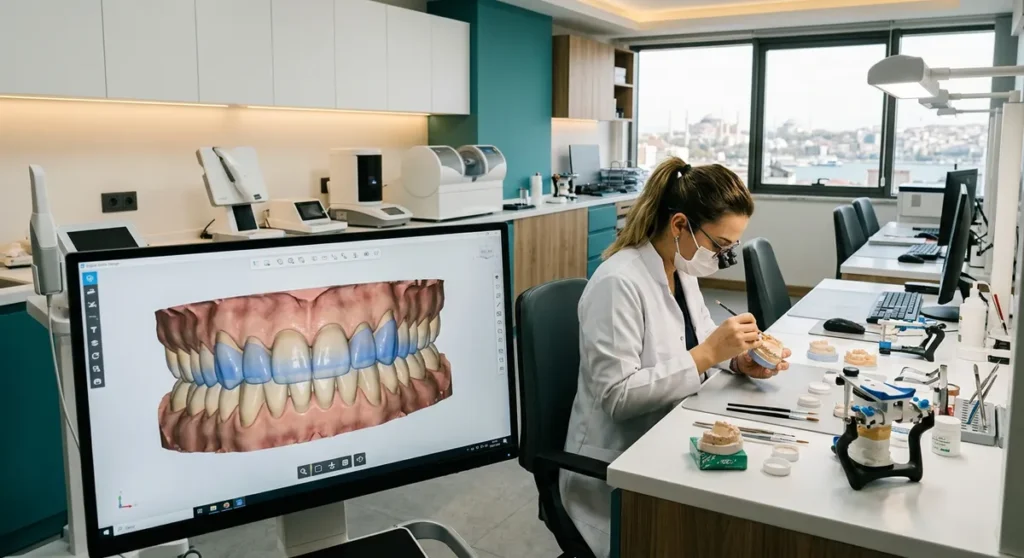
E-max porcelain veneers last 10–15 years on average with proper oral hygiene. Some patients keep theirs for 20+ years. The main factors are bite force, grinding habits, and how well you take care of your teeth.
What shortens veneer lifespan: grinding your teeth at night without a night guard, biting ice or bottle caps, poor dental hygiene causing gum recession around the veneer margins. None of these are veneer-specific problems – they’d damage natural teeth too.
Composite veneers last 5–7 years. Lumineers, being ultra-thin, tend to last 7–12 years. Porcelain remains the most durable option.
The warranty term for veneers is written in your treatment plan; zirconia crowns carry a 20-year certificate. If a veneer cracks, chips, or debonds within that period, the clinic replaces it at no charge. After that period, a replacement veneer is from €240 – a fraction of what you’d pay at home.
One honest note: veneers aren’t forever. Plan for eventual replacement. The good news is that with minimal-prep technique, your natural tooth underneath stays healthy enough for a second set down the road.
How Do We Choose Your Dentist?
We work with 2 prosthodontic clinics in Istanbul, selected after personally reviewing their cases, lab partnerships, and patient outcomes. Each dentist specializes in cosmetic and restorative work and places 300+ veneer cases per year.
We match you to the dentist based on your case. Simple 8-veneer cases go to our cosmetic dentist. Complex full-mouth rehabilitations – 20 veneers with gum contouring and bite correction – go to our senior prosthodontist. And the digital smile design review happens before you fly, not after you’ve already paid.
Here’s something no one talks about in dental tourism marketing: the lab matters as much as the dentist. A perfect prep means nothing if the lab technician can’t match the shade and translucency. Our clinics use in-house labs with CEREC milling and hand-layered finishing. The technician who makes your veneers sees your face, not just a digital file.
Already have a quote from another clinic?
We will check it line by line for free — what is missing and what usually gets added after arrival. How we check
Send your quote on WhatsAppWhat Real Patients Ask Us (FAQ)
“Will my veneers look fake?” Not if the shade and shape match your face. The “chiclet teeth” look comes from choosing a shade that’s too white and a shape that’s too uniform. Our dentists use a natural shade range (typically BL1–A1 on the VITA scale) and vary the translucency between front and side teeth. Real teeth aren’t perfectly identical. Good veneers shouldn’t be either.
“Does veneer preparation hurt?” Preparation is done under local anesthesia. You feel pressure, not pain. Minimal-prep cases involve so little reduction that some patients are surprised when the dentist says “we’re done.” Post-prep sensitivity lasts 1–3 days and responds to over-the-counter painkillers.
“Can I get veneers if I grind my teeth?” Yes, but you’ll need a custom night guard afterward. Grinding (bruxism) is the number one cause of veneer fractures. We include a night guard in every treatment plan for patients who show signs of grinding.
“Should I get veneers on all teeth or just the front ones?” Most patients get 8–12 veneers covering the upper smile zone. Lower teeth are less visible and often don’t need veneers. Some patients add 6–8 lower veneers for symmetry. Full sets of 20 are for cases with widespread damage, discoloration, or misalignment. Your dentist recommends based on what’s visible when you smile, not a fixed number.
“When should I NOT get veneers?” If your teeth are healthy with minor staining, professional whitening is cheaper and preserves 100% of your enamel. Small chips can be fixed with composite bonding in a single session. Veneers are for significant color issues, shape correction, closing gaps, or fixing worn-down teeth. A good dentist talks you out of veneers when you don’t need them.
“What’s included in the price?” At Santé: veneers, temporary veneers, digital smile design, 3D scan, shade consultation, hotel (4–5 star), airport transfers, and follow-up video calls at 1, 3, and 6 months. Flights are on you. No hidden costs – the quote is the final price.
Ready to Get a Real Quote?
Send us a photo of your smile and tell us what you’d like to change. Within 24 hours, you’ll get a treatment plan with exact veneer count, type, shade recommendation, and total price. No “starting from” ranges.
If you’re not sure whether you need veneers or something simpler, we’ll tell you that too. We turn away patients who’d be better served by whitening or bonding. A smaller treatment done right beats an unnecessary full set.
WhatsApp: +90 546 229 38 34
Or fill out the contact form and we’ll call you back.
See our full price list for all dental treatments, or learn about dental implants if your case involves missing teeth alongside veneers.
FAQ
Can't find what you're looking for?
Contact us
or message us
Quick answers to questions
you may have
Your Most Important Questions, Answered
How long do aesthetic dental treatments last?
With proper care, porcelain veneers last 15-20 years, E-max crowns 10-15 years, zirconia crowns 15-20 years, and composite bonding 5-7 years. Longevity depends on oral hygiene, lifestyle habits (grinding, diet), and regular professional maintenance. Turkish clinics provide 5-10 year warranties, though restorations often exceed warranty periods with good care.
Will my aesthetic dental work look natural?
Absolutely. Modern aesthetic dentistry creates natural-looking results through Digital Smile Design, considering your facial proportions, skin tone, age, and personality. Today’s materials mimic natural tooth translucency and color variation. The goal is enhancement, not artificial perfection – people notice you look great without realizing you’ve had dental work.
Can aesthetic dentistry fix crooked teeth?
Minor misalignment can be corrected with veneers creating the illusion of straight teeth. Moderate issues might need orthodontic treatment first, then veneers for perfection. Severe misalignment requires braces or Invisalign before aesthetic work. Your dentist will recommend the best sequence for optimal results.
Is it worth traveling to Turkey for aesthetic dentistry?
For extensive work, absolutely. Savings of 60-70% on identical materials and techniques make it financially smart. Add the ability to combine with other treatments like teeth whitening, implants, or even facial aesthetics, and the value increases. Many patients save enough to cover flights, accommodation, and a vacation.
What if I need adjustments after returning home?
Reputable Turkish clinics maintain partnerships with dentists in major cities for minor adjustments under warranty. For significant issues (rare), clinics cover return flights to Istanbul. Digital records and clear communication protocols ensure continuity of care. This support network is why choosing established clinics matters.
Can I see my results before treatment?
Yes, through Digital Smile Design. You’ll see 3D simulations of your new smile and collaborate in the design process. Many clinics create physical mock-ups you can wear to preview results. This eliminates guesswork – you approve your new smile before any permanent work begins.
How do I maintain veneers and crowns?
Maintain them like natural teeth with good hygiene, regular professional cleanings, and avoiding harmful habits (biting hard objects, grinding). Use non-abrasive toothpaste, soft-bristled brushes, and wear night guards if you grind. With proper care, your investment lasts decades.
Why our prices say «from»
Every figure on this page is a starting price for one confirmed, specific option — not an average and not a package. What changes the final number:
- the brand and material you choose — an implant starts at €280 (Swiss) and reaches €800 (Straumann); a veneer is €120 in composite and €240 in E.max
- how many teeth are treated
- whether the bone needs preparation — grafting (€120 per 1cc) or a sinus lift (€150–250)
- the condition of the gums — periodontal treatment before implants is quoted separately
- whether anything has to be treated or removed first — root canals, fillings, extractions
The final amount is confirmed by the doctor after a panoramic X-ray or an in-person assessment — until then any figure, including ours, is an estimate. We quote from a single confirmed price list, so the number you hear on WhatsApp is the same one you see here. If you are already in Istanbul, the consultation and the X-ray are free.