Dental cleaning in Turkey from €200. Deep cleaning, laser gum therapy, periodontal care. Real prices March 2026. Combine with implants or veneers. Santé.
How Much Does Dental Cleaning Cost in Turkey in 2026?
A professional dental cleaning in Istanbul costs from €200 per session as of March 2026. Deep cleaning (scaling and root planing) for gum disease runs from €150 per session, compared to €800–1,500 in the UK. Laser gum therapy is quoted after your X-ray; in the UK it costs €600–1,200.
Like other minor dental procedures, a standard cleaning alone doesn’t justify flying to Istanbul. The real value comes when hygiene treatment is part of a bigger plan – preparing for veneers, maintaining dental implants, or treating gum disease that’s been neglected.
| Treatment | Turkey (2026) | UK | Germany | USA |
|---|---|---|---|---|
| Routine Cleaning | from €200 | €100–200 | €80–150 | $100–300 |
| Deep Cleaning (full mouth) | from €150 per session | €800–1,500 | €600–1,200 | $800–2,000 |
| Laser Gum Therapy | Quoted after your X-ray | €600–1,200 | €500–1,000 | $700–1,500 |
| Gum Graft (per area) | Quoted after your X-ray | €800–1,500 | €600–1,200 | $800–2,000 |
Why Is Dental Hygiene Critical Before Other Treatments?
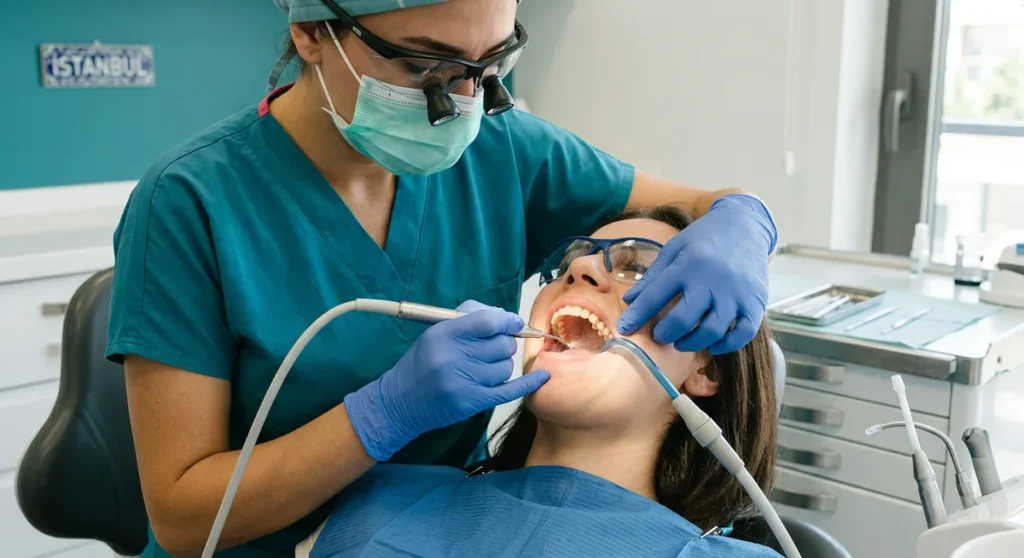
Every major dental procedure starts with healthy gums. This isn’t a sales pitch – it’s clinical reality. Your dentist in Istanbul will insist on a hygiene assessment before any cosmetic or restorative work begins.
Before veneers: Inflamed gums bleed during impression-taking, which ruins the fit. Gum recession can expose veneer margins within a year. We clean and treat gum issues first, then start cosmetic work once the tissue is stable.
Before implants: Gum disease bacteria around the implant site cause peri-implantitis – the leading cause of implant failure. A thorough cleaning and periodontal assessment before implant surgery significantly reduces this risk.
Before whitening: Tartar buildup blocks whitening gel from reaching the tooth surface. A cleaning immediately before whitening gives dramatically better, more even results.
After five years working with dental clinics in Istanbul, I’ve seen this pattern repeatedly: patients arrive for veneers or implants, the dentist discovers untreated gum disease, and the cosmetic work has to be postponed. If you suspect gum issues (bleeding when brushing, bad breath, receding gums), tell us during your initial consultation. We’ll schedule hygiene treatment first and plan the rest of your work accordingly.
What Dental Hygiene Treatments Are Available?
Four levels of hygiene treatment are offered at our partner clinics, from routine maintenance to advanced gum rehabilitation.
Routine scaling and polishing. Removes tartar (calcified plaque) above the gum line and polishes tooth surfaces. Takes 30–45 minutes. Recommended every 6 months for healthy patients, every 3–4 months for patients with a history of gum disease.
Deep cleaning (scaling and root planing). For patients with periodontitis – gum disease that has progressed below the gum line. The dentist or periodontist cleans tartar deposits from the root surfaces, smoothing them so gums can reattach. Local anesthesia is used. Typically done in 2 sessions (upper and lower jaw), but our clinics can complete both in one visit for international patients.
Laser gum therapy. Uses a diode laser to remove infected tissue and kill bacteria in deep periodontal pockets. Less painful than traditional deep cleaning, faster healing, and better results for moderate to severe gum disease. Our partner clinics in Istanbul use the Biolase and Fotona laser systems.
Gum grafting. For patients with significant gum recession exposing tooth roots. Tissue is taken from the palate (or donor tissue is used) and grafted onto the receded area. This is a surgical procedure done under local anesthesia, taking 45–60 minutes per area. Recovery takes 1–2 weeks.
Let me be honest about something: if your dentist at home told you that you have mild gingivitis and to “just brush better,” but you still have bleeding gums after months of good hygiene, you likely need professional deep cleaning. Brushing alone can’t remove tartar that’s already calcified below the gum line.
What Does the Treatment Process Look Like?
For hygiene treatment combined with other dental work, the cleaning typically happens on Day 1 of your Istanbul visit, clearing the way for cosmetic or restorative procedures in the following days.
Assessment. Full periodontal charting – measuring pocket depths around every tooth. This takes 15–20 minutes and tells the periodontist exactly where the disease is and how severe it is. X-rays reveal bone loss that isn’t visible clinically.
Treatment. Scaling with ultrasonic instruments (faster, less discomfort than manual scraping), followed by hand scaling for precision. For deep cleaning cases, local anesthesia is applied and root planing follows. Laser therapy may be added for pockets deeper than 5mm.
Polishing and fluoride. After scaling, teeth are polished with a prophylaxis paste and a fluoride varnish is applied. This strengthens enamel and reduces sensitivity.
Aftercare. Gums may feel tender for 1–2 days. Sensitivity to hot and cold is normal after deep cleaning – it resolves as the gums heal and tighten around the teeth. We recommend chlorhexidine mouthwash for 7–10 days after deep cleaning.
Follow-up. If gum disease was treated, a follow-up assessment at 6–8 weeks shows whether pockets have reduced. For international patients, this is done via video call with intraoral photos.
How Do You Maintain Results After Treatment?
Professional cleaning gives you a clean slate. Keeping it that way is on you. Here’s what actually works.
Electric toothbrush. Not optional. An Oral-B or Sonicare removes significantly more plaque than manual brushing. Brush for 2 full minutes, twice daily. Don’t press hard – let the bristles do the work.
Interdental cleaning. Floss or interdental brushes (TePe or similar) once daily. This cleans the 35% of tooth surface your brush can’t reach. For implant patients, this is even more critical – peri-implantitis often starts in the spaces between implants where food packs.
Regular professional cleanings. Every 6 months for healthy patients, every 3–4 months for patients with a history of gum disease or implants. These can be done locally – you don’t need to fly to Istanbul for maintenance cleanings.
No smoking. Smoking is the single biggest risk factor for gum disease progression. It restricts blood flow to the gums, masks symptoms (smokers often don’t bleed even with advanced disease), and dramatically slows healing after treatment.
Already have a quote from another clinic?
We will check it line by line for free — what is missing and what usually gets added after arrival. How we check
Send your quote on WhatsAppWhat Real Patients Ask Us (FAQ)
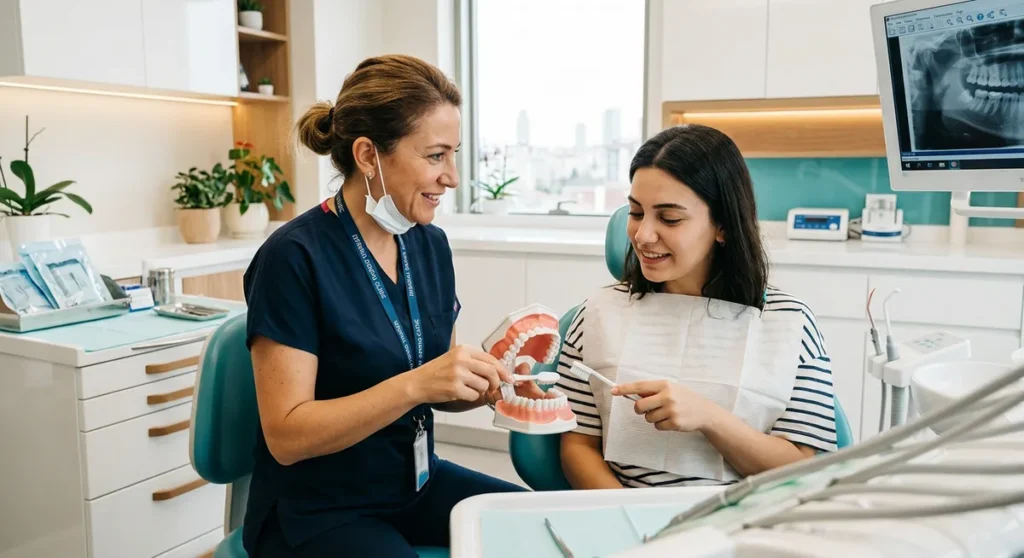
“Can gum disease be reversed?” Gingivitis (early stage) is fully reversible with professional cleaning and improved home care. Periodontitis (bone loss) is not reversible – but it can be stopped and managed. The goal of treatment is to halt progression and prevent tooth loss.
“Is deep cleaning painful?” With local anesthesia, you shouldn’t feel pain during the procedure. Post-treatment tenderness lasts 1–2 days. Laser-assisted deep cleaning is gentler and has a faster recovery than traditional methods.
“How do I know if I have gum disease?” Common signs: bleeding when brushing or flossing, persistent bad breath, swollen or red gums, receding gum line, loose teeth. But early gum disease can be painless and invisible to you – which is why professional assessment matters.
“Do I need a periodontist or a regular dentist?” For routine cleaning, a dental hygienist is fine. For moderate to severe gum disease, bone loss, or gum grafting, you want a periodontist – a dentist with additional specialization in gum treatment. Our partner clinics have both on staff.
“How often should I clean around my implants?” Professional cleaning every 3–4 months for the first 2 years after implant placement, then every 6 months if everything is stable. At home, use an interdental brush around each implant daily. Read more about implant care on our dental implants page.
Ready to Get Started?
If you’re planning dental work in Istanbul, hygiene treatment will likely be part of your visit. Send us your X-rays and let us know what else you’re considering – we’ll build a treatment plan that starts with healthy gums.
If you’re dealing with gum disease specifically, we’ll connect you with a periodontist at one of our partner clinics for a virtual assessment.
WhatsApp: +90 546 229 38 34
Or fill out the contact form and we’ll reply within 24 hours.
FAQ
Can't find what you're looking for?
Contact us
or message us
Quick answers to questions
you may have
Your Most Important Questions, Answered
Is dental hygiene treatment really necessary if I brush and floss?
Yes, absolutely. Even with excellent home care, calculus forms in areas you can’t reach, and bacterial biofilm develops that regular brushing can’t remove. Professional cleaning removes what home care misses, plus allows early problem detection. Studies show professional hygiene every 6 months reduces cavity risk by 30% and gum disease by 40%.
How is dental hygiene in Turkey different from UK hygienist appointments?
Turkish hygiene appointments are longer (60-90 minutes vs 20-30 minutes), often performed by specialist periodontists rather than hygienists, and use advanced technology like lasers and air polishing. The thorough approach catches problems early. Many UK patients learn more about their oral health in one Turkish appointment than years of UK visits.
Can gum disease really be reversed?
Gingivitis (early gum disease) is completely reversible with professional treatment and good home care. Periodontitis (advanced gum disease) can be arrested and controlled. Turkish periodontists use regenerative techniques that actually regrow lost bone and attachment in some cases – procedures rarely offered in UK due to cost.
Is laser gum treatment worth the extra cost?
Laser treatment often isn’t “extra” in Turkey – many clinics include it standard. Benefits include less discomfort, faster healing, better bacterial elimination, and avoiding surgery. Studies show laser-assisted treatment has better outcomes. In Turkey it is quoted after your X-ray; in the UK it adds £400-600.
How often should I have professional cleaning?
Depends on your oral health: healthy patients every 6 months, gingivitis every 3-4 months, active periodontitis every 3 months minimum. Smokers, diabetics, and those with genetic susceptibility need quarterly maintenance. Your periodontist determines your ideal interval based on specific risk factors.
Will deep cleaning hurt?
With proper anesthesia, you feel pressure but no pain during treatment. Turkish clinics use topical gel before injections and computer-controlled anesthetic delivery for comfort. Post-treatment sensitivity lasts 2-3 days, well-managed with medications. Many choose sedation for extensive deep cleaning, making it completely comfortable.
Can I combine dental hygiene with other treatments?
Yes, and it’s recommended. Professional hygiene before any dental work improves outcomes. Turkish clinics coordinate efficiently – hygiene first, then cosmetic work after gums heal (1-2 weeks). For implants, hygiene 1-2 weeks prior reduces infection risk significantly. Packages often include hygiene automatically.
Why our prices say «from»
Every figure on this page is a starting price for one confirmed, specific option — not an average and not a package. What changes the final number:
- the brand and material you choose — an implant starts at €280 (Swiss) and reaches €800 (Straumann); a veneer is €120 in composite and €240 in E.max
- how many teeth are treated
- whether the bone needs preparation — grafting (€120 per 1cc) or a sinus lift (€150–250)
- the condition of the gums — periodontal treatment before implants is quoted separately
- whether anything has to be treated or removed first — root canals, fillings, extractions
The final amount is confirmed by the doctor after a panoramic X-ray or an in-person assessment — until then any figure, including ours, is an estimate. We quote from a single confirmed price list, so the number you hear on WhatsApp is the same one you see here. If you are already in Istanbul, the consultation and the X-ray are free.