FUE hair transplant in Turkey from €2,500. Real 2026 prices, day-by-day process, graft counts by Norwood scale. All-inclusive packages with hotel and PRP.
How Much Does a FUE Hair Transplant Cost in Turkey in 2026?
A FUE hair transplant in Istanbul costs from €2,500 as of March 2026. The same procedure runs £8,000–15,000 in the UK, €6,000–12,000 in Germany, and $10,000–20,000 in the USA. Packages at Santé include hotel, airport transfers, PRP, medications, and an aftercare kit.
The price gap shocks people every time. A guy in his thirties gets quoted $15,000 at a clinic in New York, then finds out he can get the same procedure in Istanbul from €2,500 with a 4-star hotel included. He doesn’t trust it.
Fair enough. Here’s why the gap exists: Turkish clinics pay a fraction of what Western clinics pay for rent, staff salaries, and malpractice insurance. The tools are identical. The micro-punch instruments, the sapphire blades, the implanter pens – all manufactured by the same companies. A Choi pen used in Istanbul is the same Choi pen used in London.
What changes is the operating cost. Not the quality of the graft.
| Treatment | Turkey (2026) | UK | Germany | USA | You Save |
|---|---|---|---|---|---|
| FUE Hair Transplant | from €2,500 (all-inclusive) | £8,000–15,000 | €6,000–12,000 | $10,000–20,000 | 70–85% |
| DHI Hair Transplant | from €2,500 (all-inclusive) | £10,000–18,000 | €8,000–15,000 | $12,000–25,000 | 70–80% |
Every package includes: 4–5 star hotel (3 nights), airport transfers, pre-op blood tests, the FUE procedure, one PRP session, prescribed medications, and a full aftercare kit with shampoo, lotion, and a neck pillow. There’s no line item that shows up after you land.
Want to see the exact breakdown for your case? Send your photos on WhatsApp and we’ll quote within 24 hours. Or check our prices page for the full list.
What's the Difference Between FUE and DHI?
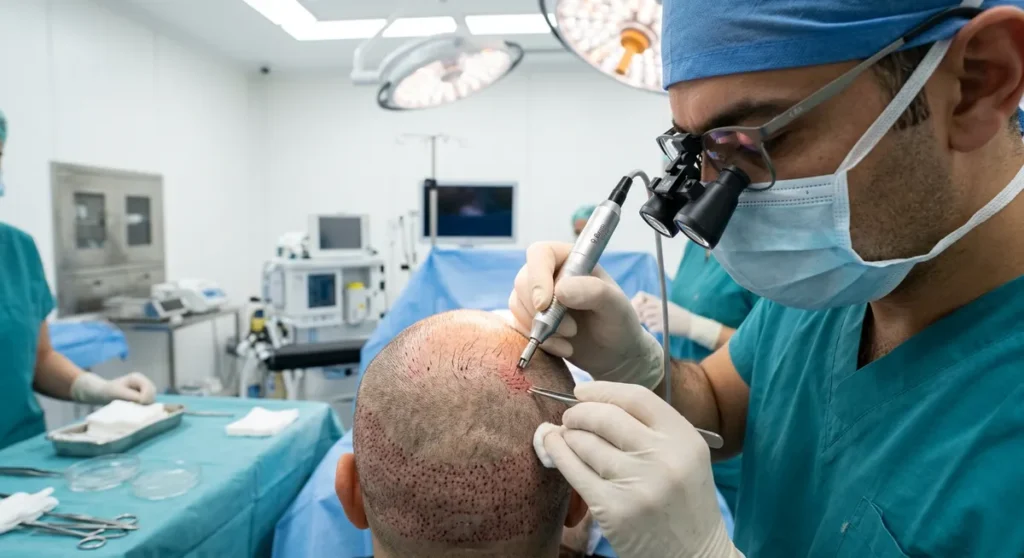
FUE (Follicular Unit Extraction) removes individual grafts from the donor area using a micro-punch tool, then the surgeon creates channels and implants each graft separately. DHI (Direct Hair Implantation) uses a Choi pen to implant grafts directly without pre-made channels. DHI costs more.
Both techniques extract grafts the same way. The difference is what happens after extraction.
With FUE, the surgeon makes tiny incisions (channels) in the recipient area first, usually with a sapphire blade, then places each graft into those channels. Two-step process. With DHI, the surgeon loads each graft into a Choi implanter pen and inserts it directly – channel creation and implantation happen in one motion.
So which one is better? Depends on the case.
DHI works best for: – Hairline refinement where angle and direction matter most – Adding density between existing hairs (no need to shave the area) – Smaller sessions, typically under 3,000 grafts
FUE with sapphire blades works best for: – Larger sessions (3,000–5,000+ grafts) – Covering wide areas like the crown – Patients on a tighter budget
I’ve seen clinics push DHI as “the premium option” to charge more. Sometimes it is the right call. But for a Norwood 4–5 patient needing 4,000 grafts, FUE with sapphire blades will give the same result for less. We recommend based on your hair loss pattern, not on which technique has a higher margin.
What Does the Hair Transplant Process Look Like Day by Day?
The entire process takes 3–4 days in Istanbul. One day for the procedure, one day for PRP and check-up, and the rest is recovery. Most patients fly home on day 3 or 4. Here’s the full timeline.
Before you fly: Send us clear photos of your hair from five angles (front, both sides, top, back). My partner reviews them with the surgeon. You get a treatment plan with the graft count, technique recommendation, and price. No guesswork when you arrive.
Day 1 – Arrival. Our driver meets you at Istanbul Airport. You check into the hotel – usually in Sisli or Besiktas, both central neighborhoods with good restaurants and easy access to the clinic. If you arrive before noon, we can do the in-person consultation that afternoon: hairline design, blood tests, and final plan confirmation.
Day 2 – Procedure day. Local anesthesia. You’re awake the entire time. Most patients watch Netflix on a tablet or fall asleep. The procedure takes 5–8 hours depending on graft count. A 2,500-graft FUE runs about 6 hours. You walk out the same day with a bandage on the donor area.
The important part: the surgeon is in the room. At Santé, the surgeon who designed your hairline is the one extracting and placing every graft. Not a technician. More on this below.
Day 3 – First wash and PRP. We do the first hair wash at the clinic (we’ll teach you how to do it at home going forward). Then a PRP therapy session to speed up healing. The surgeon checks the grafts and donor area. You’re free for the rest of the day.
Day 4 – Fly home. Final check-up if needed, then our driver takes you to the airport. By now the redness has already started fading.
Weeks 1–2 (at home): Gentle washing daily with the provided shampoo. Scabs fall off naturally. Sleep with your head propped up. No gym, no swimming, no direct sun.
Weeks 2–4: The transplanted hairs fall out. This is normal and expected – it’s called shock loss. The follicles are alive underneath.
Months 3–6: New growth starts. Thin at first, then thicker each month.
Months 8–12: Final results. Full density, natural direction, permanent.
We include 3 follow-up video consultations in every package – at months 1, 4, and 8. “What if something goes wrong after I fly home?” is the most common fear we hear. The video check-ins exist precisely for this.
How Do We Choose Your Surgeon?
We work with 2 hair transplant clinics in Istanbul, not 20. Each surgeon has performed 3,000+ FUE procedures and operates 6 days a week. My partner has personally observed their work, spoken with past patients, and reviewed their complication records.
Here’s the part nobody in this industry wants you to read.
At many clinics in Turkey – including some of the big names – the surgeon draws your hairline, makes the incisions, then leaves the room. Technicians do the extraction and implantation. That’s 90% of the actual work. The surgeon might be doing the same thing at another clinic across town that same afternoon.
I lived in Turkey for 5 years. I’ve seen this firsthand. Doctors work in 3–4 clinics simultaneously. When a clinic advertises “a famous surgeon’s name,” they don’t mention he’s there for 45 minutes out of your 6-hour procedure.
This is the single biggest difference between Santé and the agency model. Our surgeon does the full procedure. Extraction, channel creation, implantation. And my partner is at every appointment – not because we’re paranoid, but because quality drops the moment nobody’s watching.
You’ve probably heard of Vera Clinic, Dr. Serkan Aygin, Smile Hair Clinic. They’re established names and they do real volume. But volume is exactly the concern. When a clinic runs 8–10 transplants per day, the math doesn’t work for one surgeon to handle everything. At our partner clinics, the surgeon takes 1–2 patients per day. That’s it.
Are Hair Transplants in Turkey Safe?
FUE hair transplants have a 95–98% graft survival rate when performed by experienced surgeons, according to research published on PubMed. Turkey performs more hair transplants than any other country – over 500,000 procedures per year, based on ISHRS data.
But “Turkey is safe” is too broad. Some clinics are excellent. Some are terrible. The country isn’t the variable – the clinic is.
Red flags to watch for:
- Price under $1,000. The tools, staff, and facility for a proper FUE cost more than that. If it’s $800 “all-inclusive,” corners are being cut somewhere.
- “Unlimited grafts” marketing. Your donor area has a finite supply. A surgeon who extracts too aggressively leaves that area thin and unnatural.
- No named surgeon. If you can’t find the surgeon’s name, credentials, and photo before you book, that’s a problem.
- WhatsApp-only communication. A real clinic has a real team that answers questions in detail, not auto-replies.
What we do differently: you get the surgeon’s name and background before your consultation. The treatment plan specifies the graft count based on your actual Norwood classification, not a sales target.
I won’t tell you we’ve never had a patient who was unhappy with growth speed or wanted more density. That happens. What I will tell you is that when it does, the surgeon reviews the case on video and, if needed, we arrange a touch-up session.
How Many Grafts Do I Need?
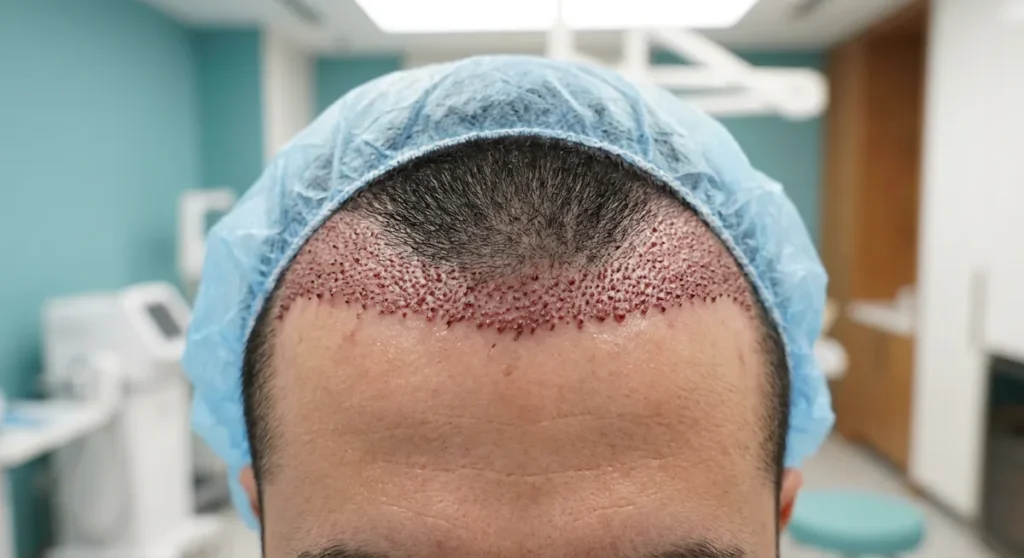
Graft count depends on your hair loss stage, measured on the Norwood scale. A Norwood 3 (receding hairline, temples thinning) typically needs 1,500–2,000 grafts. Norwood 4–5 (visible crown thinning) needs 3,000–4,000. Norwood 6 and above requires 5,000+ grafts, sometimes across two sessions.
| Norwood Stage | Hair Loss Pattern | Typical Graft Count | Approximate Cost (Turkey) |
|---|---|---|---|
| 2–3 | Receding temples, early thinning | 1,500–2,000 | Quoted after consultation |
| 3–4 | Temple recession + crown thinning | 2,500–3,500 | Quoted after consultation |
| 4–5 | Significant crown and frontal loss | 3,000–4,500 | Quoted after consultation |
| 6+ | Extensive loss, narrow donor strip | 5,000–6,000+ | Quoted after consultation |
Two things to keep in mind. First, your donor area (back and sides of your head) has a limited supply. A surgeon who extracts too aggressively leaves that area thin and unnatural. Good surgeons protect the donor. Second, sometimes two sessions spaced 8–12 months apart produce a better result than cramming everything into one marathon procedure.
If you’re a Norwood 6 or 7, hair transplant alone might not be enough. We’ll tell you that upfront. Combining FUE with ongoing hair mesotherapy or PRP sessions can protect your existing hair while the transplanted grafts mature. And if medical therapy like finasteride or minoxidil would help, the surgeon recommends that too – check our hair loss therapy page for more.
We don’t sell you 5,000 grafts when 3,000 will do. The surgeon counts what’s needed, quotes it, and that’s the number.
When Will I See Results?
Transplanted hair starts growing at 3–4 months, with noticeable density by month 6 and full results between 8–12 months. The waiting period is the hardest part – not the surgery, not the recovery. Just patience.
Month 1: Transplanted hairs fall out. You look roughly the same as before the transplant, sometimes worse because of residual redness. This is normal. The follicle is alive under the skin.
Month 3: Fine, wispy hairs start appearing. Not impressive yet. Don’t panic.
Month 5–6: Real growth. You start seeing coverage. Hairs are still thin but getting thicker each week.
Month 8–10: Significant density. This is when most patients say, “Okay, it worked.” The new hair looks and feels natural. You can style it, cut it, treat it like your own hair. Because it is.
Month 12+: Full result. Final thickness and density. The transplanted follicles are permanent – they’re taken from the donor area, which is genetically resistant to the hormones that cause hair loss.
One honest note: not every graft survives. The 95–98% survival rate means that out of 3,000 grafts, 60–150 may not take. This is true at every clinic in the world, including the most expensive ones in Beverly Hills. A good surgeon accounts for this in the initial graft count.
What Real Patients Ask Us (FAQ)
“Does it hurt?” The local anesthesia injections sting for about 30 seconds. After that, nothing. Some clinics use a needle-free anesthesia device that reduces even that initial discomfort. During the procedure itself, zero pain.
“Will people know I had a transplant?” Not if it’s done well. A skilled surgeon places grafts at the correct angle and density so the hairline looks natural, not pluggy. Modern FUE, done properly, is undetectable.
“Can I shave my head after?” Yes, but not down to skin level. With a good FUE, you can go to a grade 2–3 buzz cut without visible scarring. The micro-punch marks are nearly invisible.
“What if I keep losing hair after the transplant?” The transplanted hair is permanent. But your existing hair might continue thinning if you don’t treat the underlying cause. That’s why most surgeons recommend finasteride or minoxidil alongside the transplant. PRP sessions every 6–12 months also help maintain existing hair.
“How soon can I go back to work?” Most office workers return after 5–7 days. The redness and small scabs are visible for 10–14 days. If you work from home, 3 days is enough. Gym and heavy exercise: wait 3–4 weeks.
“I’ve seen clinics offering $800 transplants. Why shouldn’t I go there?” Because at $800, either the surgeon isn’t doing the work, the tools are reused, or the graft count is inflated to sell you on the price. A proper FUE with a real surgeon, new instruments, and quality aftercare costs $1,500 minimum. Below that number, the economics don’t work.
Ready to Get a Real Quote?
Send us 5 photos of your hair (front, top, both sides, back of head) on WhatsApp. Within 24 hours, you’ll receive a treatment plan with the exact graft count, technique recommendation (FUE or DHI), price, and timeline. No “starting from” ranges.
WhatsApp: +90 546 229 38 34
Or fill out the contact form and we’ll call you back.
FAQ
Can't find what you're looking for?
Contact us
or message us
Quick answers to questions
you may have
Your Most Important Questions, Answered
How many grafts will I need for good coverage?
Graft requirements depend on your Norwood scale level and desired density. Norwood 2-3: 1500-2500 grafts. Norwood 3V-4: 2500-3500 grafts. Norwood 5-6: 4000-5500 grafts. Norwood 7: May need multiple sessions. Your surgeon calculates exact needs based on donor density and recipient area size during consultation.
Will people know I had a hair transplant?
The procedure itself is painless due to local anesthesia. Initial injections cause brief discomfort (2-3 minutes). During extraction and implantation, you feel pressure but no pain. Post-operatively, mild discomfort for 2-3 days is managed with simple painkillers. Most patients watch movies or sleep during the procedure.
Can I lose transplanted hair in the future?
Transplanted hair is permanent because it comes from the DHT-resistant donor area. These follicles maintain their genetic resistance even when moved. However, your existing native hair can continue thinning, which is why medical therapy is important to maintain overall density.
What's the difference between FUE and FUT?
FUE extracts individual follicles leaving tiny dot scars invisible to the naked eye. FUT removes a strip of scalp leaving a linear scar. FUE allows shorter hairstyles, has easier recovery, and permits multiple future sessions. FUT can harvest more grafts in one session but limits future options. FUE is now standard.
Can I have multiple FUE procedures?
Yes, many patients have 2-3 procedures over their lifetime. First session addresses immediate needs, future sessions add density or address continued loss. Donor management is crucial – experienced surgeons plan for potential future procedures. Turkey’s affordable pricing makes multiple sessions feasible.
How do I maintain results long-term?
Protect transplanted and existing hair with: finasteride/minoxidil to prevent further loss, PRP therapy every 3-4 months, good nutrition and supplements, gentle hair care products, sun protection, and healthy lifestyle. Turkish clinics provide detailed maintenance protocols and affordable follow-up treatments.
Why our prices say «from»
Every figure on this page is a starting price for one confirmed, specific option — not an average and not a package. What changes the final number:
- the area treated and the volume of work
- the technique the surgeon chooses after seeing your case
- whether the procedure is combined with another one in the same session
- implants or materials, where the case needs them
The final amount is confirmed by the doctor after a panoramic X-ray or an in-person assessment — until then any figure, including ours, is an estimate. We quote from a single confirmed price list, so the number you hear on WhatsApp is the same one you see here. If you are already in Istanbul, the consultation and the X-ray are free.