Invisalign in Istanbul: What Clear Aligners Really Cost in 2026
# Invisalign in Istanbul: What Clear Aligners Really Cost in 2026
Somebody messaged us in June with a screenshot: a clinic in Istanbul offering “Invisalign, €900, all inclusive.” He wanted to know why our number was three times that. Fair question, and the answer says more about how aligner pricing works than any price table will.
Here’s my honest position up front. Invisalign in Istanbul is the one dental treatment where flying in from Europe often doesn’t pay for itself. For implants or a full set of veneers the math is obvious. For clear aligners it depends entirely on what your home quote looks like and whether you’re coming to Istanbul for something else anyway.
How much does Invisalign in Istanbul cost in 2026?
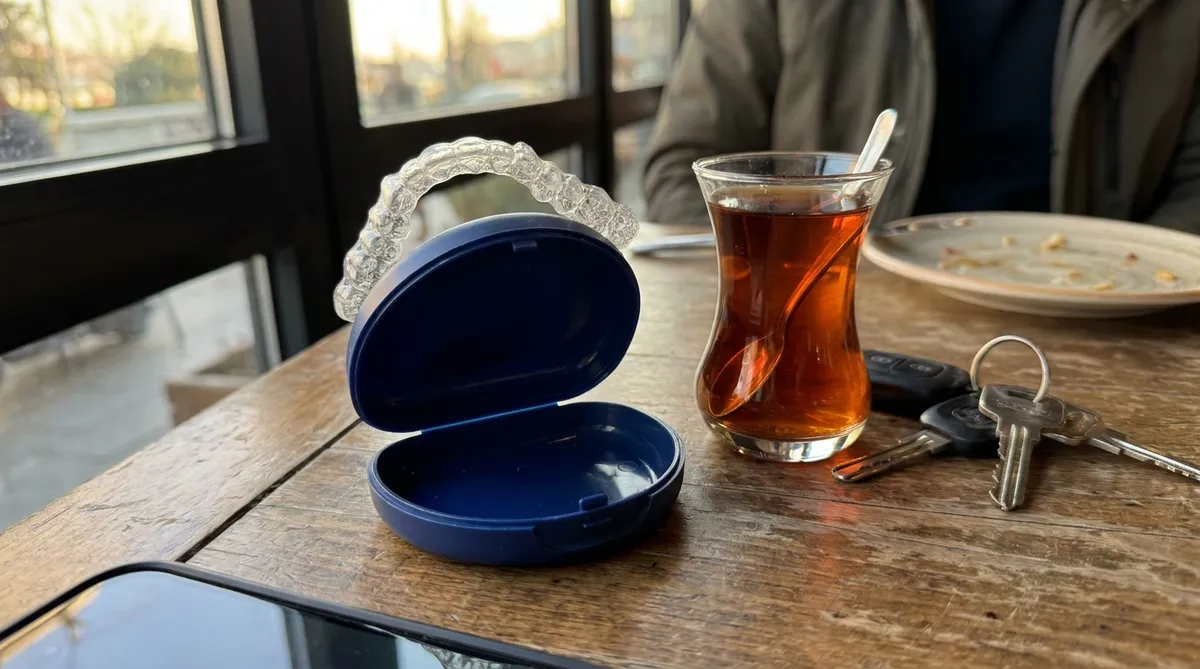
As of August 2026, a full Invisalign course at Santé Clinic costs €3,000 to €5,000, with a separate €150 aligner analysis paid before your plan is built. That band covers the whole treatment, from scan to final retainer check. Where you land inside it depends on how far your teeth have to move and what needs fixing first.
| Item | Price (August 2026) |
|—|—|
| Aligner analysis (scan, records, treatment plan) | from €150 |
| Full Invisalign course | €3,000-€5,000 |
| Simple extraction, if crowding requires it | from €60 per tooth |
| Cleaning / hygiene before starting | from €200 per session |
| Hotel and airport transfers | not included |
That last line matters, and it’s different from how we price our other work. With veneers or implants, hotel and transfers are inside the package. Aligner treatment runs over a year with short visits, so bundling accommodation into the price would mean charging you for nights you may not want. You book your own hotel; we’ll still tell you which district to book in.
One more thing about that range. It’s a range because it’s honest. The final figure comes from the orthodontist after your panoramic X-ray and scan, not from a price list, and anyone quoting you an exact number before seeing your teeth is quoting a marketing number. Our full прайс-лист works the same way.
Why is our price higher than the €900 you saw advertised?
Cheap aligner quotes in Istanbul are almost never wrong. They’re just answering a different question. A €900 offer usually means one of four things, and once you know the four, the whole market becomes readable.
It isn’t Invisalign. Align Technology’s Invisalign system is one brand among dozens of aligner manufacturers, several of them Turkish, and a clinic can legally advertise “clear aligners” for any of them. Some of the local labs produce decent work. It’s still not the same product, the same planning software or the same warranty.
It’s a short protocol. Five to ten trays for minor front-tooth rotation costs a fraction of a full arch-wide correction. If your case genuinely is that small, the cheap quote is the right quote and you should take it.
It’s one arch, not two. Upper only, priced as if it were the whole mouth.
It excludes refinements. This is the sneaky one. Teeth rarely finish exactly where the software predicted, so a second scan and a small extra series of trays is normal, not a complication. A price that assumes zero refinements is a price that will change halfway through.
What does the €150 aligner analysis actually buy?
The €150 covers a panoramic X-ray, an intraoral scan, photos, and an orthodontist building your actual movement plan in the software. You see the simulated end position before you commit to anything. If the answer is “aligners won’t fix this,” you’ve spent €150 instead of a flight and a deposit.
We charge for it deliberately. A free plan is a sales document, and I’ve read a lot of them. When a clinic gives away the diagnostic step, the plan tends to say yes to whatever the patient asked for, because the plan exists to close the sale rather than to describe the treatment.
About one in five aligner enquiries we get should not be aligner enquiries. Sometimes there’s untreated gum disease and moving teeth would be actively harmful. Sometimes the bite problem is skeletal, which no tray can move. And sometimes, most often, the person wants a cosmetic result in ten days and aligners take fourteen months.
Can you run Invisalign in Istanbul while living in Europe?
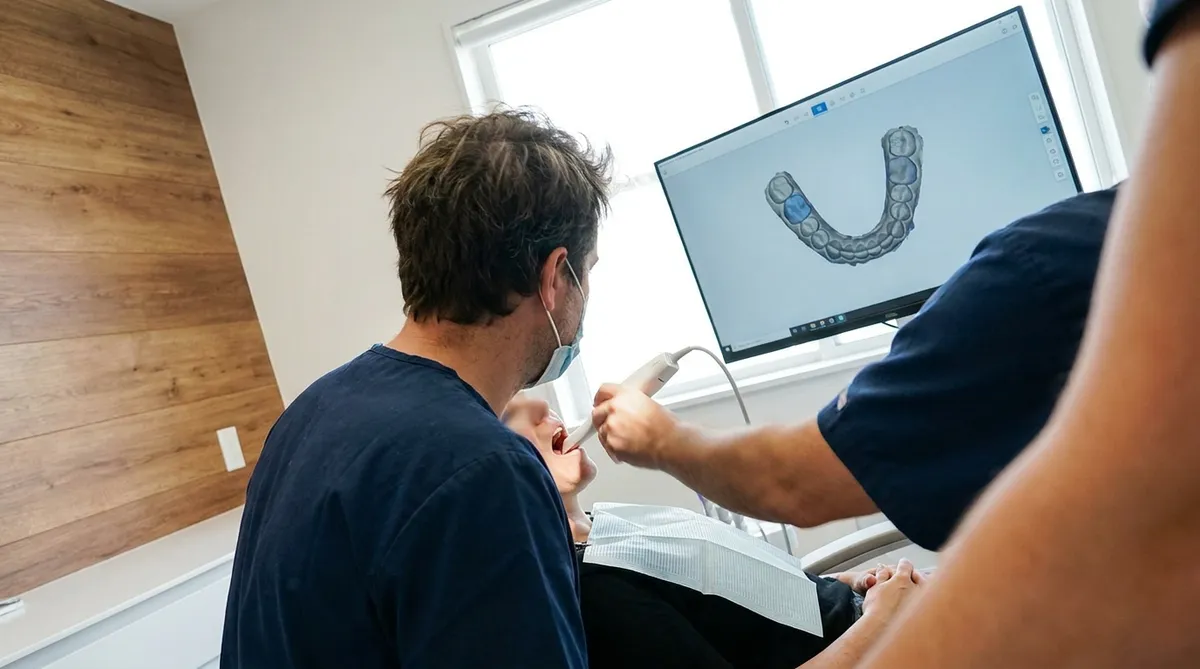
Yes, on a hybrid model: two or three trips to Istanbul across 12 to 18 months, with WhatsApp photo check-ins between them. Trip one is the scan, the attachments and the first trays. Trip two is a mid-course check and usually a refinement scan. Trip three is the finish, plus retainers.
The failure mode isn’t the flying. It’s the attachment that pops off in month four.
Those small tooth-coloured bumps are what let a plastic tray push a root rather than just tip a crown, and when one debonds, that tooth quietly stops tracking. You won’t feel it. You’ll see it four weeks later when a tray doesn’t seat properly, and by then the plan has drifted. Someone has to look at your teeth on a schedule and rebond it, which is the entire argument against being handed 30 trays and sent home.
My partner is physically in the room for every appointment our patients have, and for aligner cases that changes what the check-in is. She knows which tooth was slow last time and asks about that tooth. Istanbul orthodontists commonly work across three or four clinics in the same week, and continuity is the thing that gets lost in that arrangement; a fourteen-month treatment is where it gets lost most expensively. That, more than price, is why we exist at all.
I lived in Turkey for five years and speak the language, so I’ll add the unglamorous part: on your mid-treatment trip you will spend maybe 40 minutes in the chair and two days in Istanbul. Book in Şişli or Beşiktaş, close to the clinics. Come in April, May, September or October. August is 35°C and you’ll regret it.
Aligners or veneers: which are you actually asking for?
These solve different problems and get confused constantly. Aligners move your own teeth over roughly a year and touch no enamel. Veneers reshape the visible surface in about a week and are irreversible. Crooked-but-healthy teeth in someone with time is an aligner case; worn, discoloured or chipped teeth in someone with a deadline is a cosmetic dentistry case.
The following is a composite, drawn from patterns we see weekly rather than one identifiable patient.
Hanna, 31, wrote to us from Rotterdam in the spring asking for 16 veneers. Her lower front teeth had crowded up over a decade and she’d watched enough TikTok to know she wanted “the Turkey teeth thing,” which is also what worried her about it. The orthodontist looked at her scan and told her something she did not want to hear: her enamel was in good shape, and grinding down sixteen healthy teeth to correct a lower-arch crowding problem was a bad trade. Aligners, 14 months.
She went quiet for about three months. When she came back she said the timeline was the problem, since she’d been picturing a week off work and a finished smile. She started in June, and her honest report from month two is that the attachments annoy her more than she expected, they catch on her lip, and she’d assumed clear meant invisible. Her teeth are moving on schedule. She’s told two colleagues that the boring option was the right one, which is a better outcome than a testimonial.
The pattern under that story is common enough that the NHS orthodontics guidance says the same thing in flatter language: aligners are an orthodontic treatment with orthodontic timelines, not a cosmetic shortcut. If you want the cosmetic shortcut, we’ll quote you E-max veneers from €240 per tooth and be straight with you about what gets removed.
When flying to Istanbul for aligners genuinely pays off
Run your own numbers before you get excited. German and Austrian practices commonly quote €5,000 to €7,500 for a full course as of mid-2026, and UK private practices sit in a similar band once retainers are included. Against our €3,000-€5,000, a straightforward case saves maybe €1,500 gross. Subtract three return flights and four or five hotel nights and you might be saving €400 for the privilege of doing your orthodontics in another country.
So here’s when it works.
Your home quote is €6,000 or more. Complex cases scale badly in high-cost markets and the absolute gap gets wide enough to matter.
You’re already coming for other dental work. Combine aligners with implants or crowns and the travel cost is already spent. This is the most common version we see.
You travel to Turkey anyway. Family, work, holidays. Then the trips cost you nothing extra and the decision is easy.
You want the treatment supervised in person, and it isn’t available to you at home for that money. Fair reason.
When it doesn’t work: minor front-tooth crowding, a €2,500 quote at home, and no other reason to be in Istanbul. Take the local option. I’d rather tell you that now than after you’ve booked. Same logic applies to our orthodontic treatments page, which covers braces and the cases where aligners aren’t the answer.
What the price doesn’t include
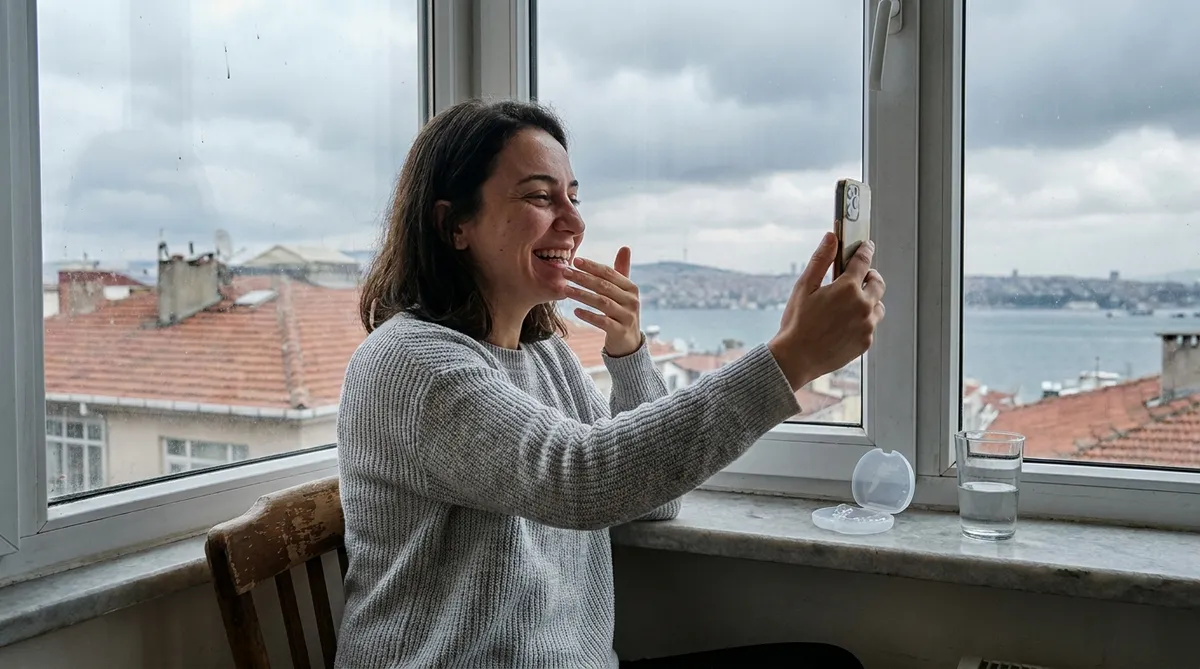
Flights are yours. Hotel and transfers are yours on aligner treatment, unlike our veneer and implant packages. Meals, obviously.
Then there’s the prep work, which is where quotes move. Crowded arches sometimes need a simple extraction, from €60 per tooth. Almost everybody needs a hygiene session before trays go in, from €200. Untreated decay gets fixed first, always, and the cost depends on what the X-ray shows.
Retainers after treatment are the line people forget. You wear one for years, not months, and you will eventually lose or crack it. Budget for replacements wherever you are in the world, because teeth drift back and that’s not a Turkish problem, it’s a tooth problem.
If a clinic’s quote has none of these lines in it, the quote isn’t finished. Ask what happens if you need a refinement, and ask in writing. Our guide on checking a dental clinic before you book has the rest of the questions worth asking.
Часто задаваемые вопросы
How much does Invisalign in Istanbul cost in 2026?
As of August 2026, a full Invisalign course at Santé Clinic costs €3,000 to €5,000, plus a €150 aligner analysis paid before the treatment plan is built. Where you land in that band depends on case complexity and whether you need extractions, hygiene or fillings first.
Is Invisalign in Turkey cheaper than in Germany or the UK?
Usually yes on the treatment itself, but the gap is smaller than for veneers or implants. German and Austrian practices commonly quote €5,000 to €7,500 for a full course. Once you add two or three return flights and hotel nights, savings on a simple case can shrink to almost nothing.
How many times do I have to fly to Istanbul for aligner treatment?
Plan for two or three trips across 12 to 18 months: one for scanning and attachments, one mid-treatment check, one for the final fit and retainers. Between visits your coordinator tracks progress by WhatsApp photos, so you’re not flying in for a five-minute look.
Can I get all my aligner trays at once and stay home?
You can physically be handed the trays, and some clinics will do it. We don’t recommend it. Attachments fall off, teeth track slower than the plan, and refinement scans are normal rather than exceptional. Nobody supervising by photo can rebond an attachment for you.
Are aligners faster than veneers for fixing crooked front teeth?
No. Veneers change how teeth look in about a week; aligners move real teeth over 12 to 18 months and leave the enamel alone. If your only goal is a fast cosmetic change before an event, aligners are the wrong tool, and we say so before you book flights.
Find out whether you’re an aligner case at all
Send us a panoramic X-ray if you have one, or just three phone photos: teeth together from the front, and both sides with your lips pulled back. Message them on WhatsApp to +90 546 229 38 34 and we’ll come back within 24 hours with an orthodontist’s read on whether aligners will work for your teeth, roughly how many months, and where in the €3,000-€5,000 band your case sits.
If the answer is that you’d be better off treating this at home, we’ll tell you that too. You can also reach us through the страница контактов if you’d rather not use WhatsApp.